What API Services are offered by Trade AI and what technology stacks are supported
What API Services Are Offered by Trade AI and What Technology Stacks Are Supported?
Navigating modern financial markets across stocks, cryptocurrencies, forex, and commodities requires speed, clarity, and deep data analysis. For individual market participants and modern digital platforms alike, the challenge is rarely a shortage of information; rather, it is transforming raw market noise into actionable, structured intelligence.
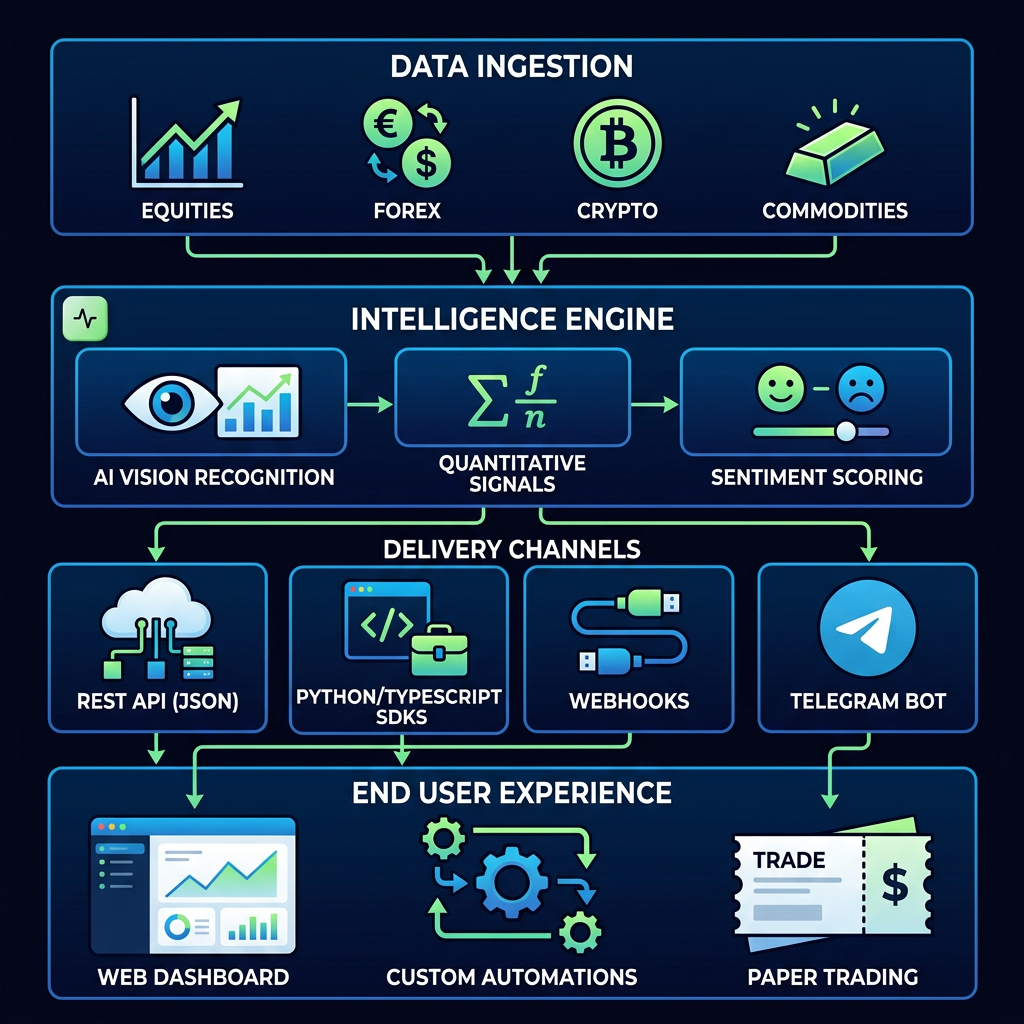
This is where Trade AI bridges the gap. Built as an end-to-end intelligence engine, Trade AI provides institutional-grade market data, computer vision chart analysis, predictive pattern detection, and automated signals. Whether you interact with Trade AI through its intuitive web dashboard, its conversational Telegram interface, or programmatic connections, understanding the underlying API services and supported technology stacks helps you unlock the full power of the platform.
In this guide, we break down the specific API services offered by Trade AI, explore the programming environments and technology stacks supported, and explain how individual traders can benefit from this advanced infrastructure.
The Core API Services Offered by Trade AI
Trade AI's backend is modular, designed to serve multiple market requirements ranging from real-time pricing to deep portfolio diagnostic checks. Here are the core services that power the Trade AI ecosystem.
1. Real-Time and Historical Market Data API
Clean, normalized market data is the foundation of every sound trading decision. The Trade AI financial market data API consolidates multi-asset feeds into a unified schema.
- Asset Coverage: Comprehensive data across equities, global foreign exchange (FX), cryptocurrencies, and commodities.
- Data Points: Real-time quotes, OHLCV (Open, High, Low, Close, Volume) candlestick intervals, end-of-day (EOD) historical pricing, and pre-calculated technical indicators (such as RSI, Moving Averages, and MACD).
- Reliability: Standardized timestamps and filtered anomalies eliminate bad ticks and fragmented feeds.
2. AI-Powered Trading Signals API
Rather than forcing users to spend hours manually monitoring dozens of charts, the AI trading signals API delivers structured market observations directly to your interface or personal tools.
- Complete Signal Structure: Each generated signal includes entry levels, invalidation stop-loss points, multi-tiered take-profit targets, directional bias (bullish/bearish), and comprehensive analytical rationale.
- Multi-Timeframe Capability: Generates signals across varying horizons, supporting intraday research, swing setups, and macro trend tracking.
- Rule-Based Consistency: Uses rigorous statistical models and algorithmic filters to ensure signals adhere to predefined risk-reward profiles.
3. Computer Vision and AI Chart Analysis API
One of Trade AI's most distinctive capabilities is its vision-based pattern engine. Using state-of-the-art visual processing, the AI chart pattern recognition service scans candlestick charts much like a veteran technical analyst would.
- Visual & Ticker-Based Input: Users and applications can either query a symbol directly or pass chart screenshots to the engine.
- Automated Structure Detection: Identifies critical support and resistance zones, trendlines, geometric chart patterns (e.g., flags, wedges, head and shoulders), and volume divergences.
- Objective Reporting: Returns clear textual summaries and coordinate-based visual markers outlining current market structure.
4. Portfolio Intelligence and Risk Insights API
Beyond individual symbol analysis, Trade AI evaluates entire portfolios to identify hidden vulnerabilities.
- Multi-Asset Aggregation: Evaluates combined holdings across crypto wallets, equity brokers, and currency accounts.
- Risk Observations: Automatically flags concentration risks, excessive sector correlation, and volatility exposure.
- Health Metrics: Supplies diversification scores and practical reallocation suggestions designed to maintain balanced portfolio exposure.
Supported Technology Stacks and Integration Ecosystem
Trade AI is built according to open, modern web standards, ensuring that retail hobbyists, community builders, and automated researchers can integrate platform capabilities into their existing setups without friction.
RESTful Web Services (HTTP / JSON)
The cornerstone of Trade AI’s connectivity is a clean REST architectural model. Every endpoint communicates via standard HTTPS, utilizing readable, lightweight JSON payloads.
- Universal Language Compatibility: Any programming environment capable of making standard HTTP requests (GET, POST) can effortlessly interact with Trade AI.
- Predictable Status Codes: Standardized HTTP response codes and descriptive error handling simplify troubleshooting.
Developer SDKs: Python and TypeScript
For traders and analysts who prefer streamlined coding over manual HTTP configuration, Trade AI supports dedicated client software development kits (SDKs):
- Python SDK: The gold standard for data science and quantitative finance. The official Python library allows analysts to integrate Trade AI data straight into Jupyter Notebooks, Pandas DataFrames, and NumPy analysis pipelines with minimal setup.
- TypeScript / Node.js SDK: Ideal for full-stack developers and automation enthusiasts building web interfaces, Discord notification bots, or serverless microservices.
Event-Driven Webhooks
Financial markets move quickly, making constant polling inefficient. Trade AI supports trading signal webhooks that deliver instant push notifications whenever a new market signal or high-impact market event occurs.
- Immediate Latency Advantage: Signals are delivered straight to your endpoint the moment they are generated.
- No-Code / Low-Code Friendly: Effortlessly connects to automation tools like n8n, Make, or Zapier, letting you pipe data into Google Sheets, Airtable, or mobile alerts without writing complex infrastructure code.
Telegram Bot and Messaging Integration
Understanding that modern traders frequently manage alerts on mobile devices, Trade AI natively supports Telegram bot connectivity.
- Interactive Commands: Users can request instant chart breakdowns, generate new signals, or review portfolio balance updates directly inside Telegram.
- Real-Time Channel Broadcasts: Community leaders and private trading groups can pipe automated alerts directly into private chat groups.
How Individual Traders Benefit from Trade AI's Technology Engine
While Trade AI offers robust infrastructure, you do not need to be a software engineer to benefit from it. The Trade AI web platform packages this advanced technology stack into a simple, user-friendly interface designed for daily retail market research.
1. Research Without Tab Overload
Instead of juggling a charting platform, news terminal, and separate crypto screeners, Trade AI unifies cross-market analysis into one screen. You can review equities, currencies, and digital assets with identical visual clarity.
2. Learn Chart Mechanics with AI Vision
If you are still developing your technical analysis skills, Trade AI's chart analysis serves as an educational companion. By uploading a screenshot or selecting an asset, you can see how AI identifies key support/resistance levels, helping you train your eye to spot valid structural breakouts.
3. Practice Safely with Trading Simulation
Before committing capital to a new technical setup or AI signal, Trade AI lets you use its integrated paper trading simulator. You can test buy and sell decisions in real-time market conditions without financial risk, building discipline and refining your personal risk management rules.
Practical Ways to Connect Trade AI to Your Workflow
Whether you are an active retail swing trader or a curious hobbyist, here is how you can practically apply these capabilities:
- Automated Spreadsheets: Use simple Google Sheets scripts or no-code webhook connectors to log Trade AI signal data, recording historical entries, stop-losses, and outcomes for your trading journal.
- Mobile Market Watcher: Connect your Trade AI profile to Telegram to receive curated, AI-scored news sentiment and chart insights while away from your desk.
- Portfolio Health Checks: Export your portfolio summaries from your broker or crypto exchange into Trade AI to discover if your assets are overly concentrated in a single sector or market cap tier.
Learn more about our comprehensive toolset by browsing our services overview or review our intuitive pricing options to pick the tier that matches your trading journey.
Summary / Key Takeaways
- Comprehensive API Suite: Trade AI provides APIs for normalized multi-asset market data, AI-generated trading signals, visual chart pattern analysis, and portfolio risk evaluation.
- Versatile Tech Stacks: Fully compatible with standard REST protocols, native Python and TypeScript SDKs, and event-driven webhooks.
- Zero Coding Required for Retailers: While the backend is developer-grade, individual traders can access all insights directly through an intuitive web application and Telegram bot.
- Educational & Objective: Designed to enhance market literacy, structure, and risk discipline rather than offer automated get-rich-quick promises.
Ready to Elevate Your Market Research?
Take the guesswork out of market analysis. With Trade AI, you gain access to institutional-quality technical tools, pattern recognition, and real-time market insights packaged into an interface built for the modern trader.
Explore Trade AI for Free Today and see how intelligent market analytics can simplify your daily trading routine.
Frequently Asked Questions (FAQ)
Do I need programming experience to use Trade AI?
No. Trade AI is fully accessible through an intuitive, web-based dashboard and an interactive Telegram bot. While developers can use the REST APIs and SDKs to build custom automations, retail users can access every signal, chart pattern breakdown, and portfolio tool directly through their browser.
What markets does the Trade AI data API cover?
Trade AI covers four primary asset classes: global equities, foreign exchange (Forex), major cryptocurrencies, and commodities. This multi-asset coverage allows you to track and analyze diversified market strategies within a single platform.
What programming languages have official Trade AI SDKs?
Trade AI currently provides dedicated software development kits (SDKs) for Python and TypeScript / Node.js, in addition to standard REST endpoints that work across any programming language capable of sending HTTP requests.
How do Trade AI webhooks work for automated alerts?
Webhooks function as automated notifications. Instead of continuously refreshing an API or web page to check for updates, you provide a destination URL. As soon as Trade AI detects a qualifying market pattern or generates a new signal, it immediately pushes a structured JSON payload to your designated URL.
Can Trade AI execute trades directly on my brokerage account?
No. Trade AI is strictly an informational, educational, and market research platform. It does not hold custody of funds, execute live broker orders, or act as an automated trading bot. You retain full control over your execution, portfolio allocation, and capital management at all times.
Disclaimer: Trade AI provides AI-generated market analysis, signals and insights for informational and educational purposes only. This content does not constitute financial, investment or trading advice, nor is it a recommendation to buy or sell any financial instrument. Markets are inherently unpredictable, and past or AI-generated analysis does not guarantee future results. Always conduct your own research and apply appropriate risk management before making any financial decision.
Frequently asked questions
- Do I need programming experience to use Trade AI?
- No. Trade AI is fully accessible through an intuitive, web-based dashboard and an interactive Telegram bot. While developers can use the REST APIs and SDKs to build custom automations, retail users can access every signal, chart pattern breakdown, and portfolio tool directly through their browser.
- What markets does the Trade AI data API cover?
- Trade AI covers four primary asset classes: global equities, foreign exchange (Forex), major cryptocurrencies, and commodities. This multi-asset coverage allows you to track and analyze diversified market strategies within a single platform.
- What programming languages have official Trade AI SDKs?
- Trade AI currently provides dedicated software development kits (SDKs) for Python and TypeScript / Node.js, in addition to standard REST endpoints that work across any programming language capable of sending HTTP requests.
- How do Trade AI webhooks work for automated alerts?
- Webhooks function as automated notifications. Instead of continuously refreshing an API or web page to check for updates, you provide a destination URL. As soon as Trade AI detects a qualifying market pattern or generates a new signal, it immediately pushes a structured JSON payload to your designated URL.
- Can Trade AI execute trades directly on my brokerage account?
- No. Trade AI is strictly an informational, educational, and market research platform. It does not hold custody of funds, execute live broker orders, or act as an automated trading bot. You retain full control over your execution, portfolio allocation, and capital management at all times.