Quantifying Market Volatility: Building a Dynamic Stop-Loss Strategy Using AI News Sentiment Scoring

Quantifying Market Volatility: Building a Dynamic Stop-Loss Strategy Using AI News Sentiment Scoring
Every trader has felt the sting of a sudden market whipsaw. You identify a solid setup, set a conventional 2% stop-loss, and step away from your screen. Minutes later, a breaking headline drops, volatility surges, your stop-loss is triggered at the absolute bottom, and the market immediately rebounds in your intended direction.
Traditional, static stop-losses treat every market environment as if it were identical. Yet, a quiet Tuesday afternoon in the forex markets is fundamentally different from a morning dominated by unexpected macroeconomic releases or earnings updates.
By quantifying market volatility and combining technical indicators with AI news sentiment scoring, retail traders can develop adaptive risk management strategies. In this guide, we explore how market sentiment impacts price swings and how you can implement dynamic stop-losses to protect your capital without getting prematurely shaken out of promising positions.
The Limitation of Static Stop-Losses in Modern Trading
For decades, conventional trading literature has recommended placing fixed percentage stop-losses—often 1%, 2%, or 3% beneath an entry price. While having a fixed exit rule is vastly superior to trading without any risk control, static levels possess a significant flaw: they ignore the current volatility regime.
The Problem with Fixed Percentages
- Premature Exits During High Volatility: In fast-moving environments—such as earnings week or major crypto market cycles—a 2% drop can occur purely from normal market "noise." Setting a narrow, static stop-loss in these conditions exposes you to high rates of false triggers.
- Excessive Risk During Calm Periods: Conversely, when an asset is trading in an unusually tight range, a wide static stop-loss gives away far more capital than necessary before recognizing that the trade thesis has failed.
To manage trades effectively, risk boundaries must breathe in tandem with market conditions. This is where dynamic stop-loss mechanisms come in.
Quantifying Market Volatility: Beyond Simple Price Movements
Before adjusting your stops automatically, you need a reliable method to measure current market conditions. Market technicians typically start with volatility indicators such as the Average True Range (ATR) or Bollinger Bands.
- Average True Range (ATR): Formulated by J. Welles Wilder, ATR measures the average range between high and low prices over a specific number of periods (commonly 14). Unlike standard percentage measurements, ATR reflects the actual asset-specific price behavior in absolute dollar or pip terms. For a deeper technical perspective, review Investopedia's guide to Average True Range.
- Standard Deviation & Volatility Bands: By measuring standard deviations from a moving average, indicators like Bollinger Bands highlight when price is stretching past standard statistical thresholds.
While these indicators provide a historical snapshot of price volatility, they are inherently lagging—they measure volatility after the candles have closed. To anticipate volatility shifts before they fully unfold on a price chart, traders are turning to real-time sentiment metrics.
What Is AI News Sentiment Scoring and How Does It Work?
Financial markets run on information. Breaking news, regulatory reports, earnings surprises, and geopolitical updates trigger immediate algorithmic and human trading reactions.
Traditionally, monitoring hundreds of news sources in real time was reserved for institutional trading desks. Today, Natural Language Processing (NLP) and artificial intelligence aggregate and parse thousands of headlines per second to produce an objective sentiment score.
Turning News into Numerical Data
AI news sentiment engines evaluate the tone, certainty, and relevance of incoming headlines across equities, crypto, commodities, and forex. Rather than simply categorizing news as "good" or "bad," the model evaluates:
- Polarity: Is the news net-positive, neutral, or negative?
- Asset Impact Score: How directly does the headline correlate with price action for that specific symbol?
- Velocity & Novelty: Is this an isolated report, or is there a sudden surge in headline volume regarding a single asset?
By transforming subjective narrative into a quantifiable metric (for example, a score ranging from -1.0 for extreme panic to +1.0 for extreme euphoria), sentiment becomes a functional variable in your risk framework.
How a Dynamic Stop-Loss Strategy Operates
When you combine a technical baseline (like ATR) with an AI sentiment modifier, your stop-loss becomes proactive rather than purely reactive.
Dynamic Stop Distance = Base Technical Volatility (ATR) × Sentiment Shock Multiplier
Here is how this dynamic adjustment works in practice across two contrasting market scenarios:
Scenario A: High Sentiment Velocity (Incoming Shock)
Imagine you are holding a long position on a major tech stock. The stock is consolidating quietly, but sudden headlines emerge regarding unexpected supply chain disruptions.
- Traditional Reaction: The ATR remains low because past candles were calm. A static or standard ATR stop sits closely under price.
- Dynamic Sentiment Adjustment: The AI sentiment score drops sharply into negative territory with high velocity. The dynamic engine flags incoming shock potential, expanding the required technical buffer or signaling an early manual review before the stop is violently hit by slippage.
Scenario B: Steady Trend with Calming Sentiment
In an orderly bull trend where sentiment remains consistently positive and neutral-to-low in headline volatility, the engine recognizes that unexpected whipsaws are less likely. The stop-loss can trail closer to key technical support levels, locking in profits without leaving unnecessary downside exposure on the table.
Putting Dynamic Risk Management into Practice with Trade AI
While quantitative hedge funds historically relied on custom scripts to connect news feeds with trading terminals, modern platforms make these tools accessible to individual retail market participants without writing complex software.
With Trade AI, traders can access unified market intelligence and automated risk parameters directly:
- AI Trading Signals: Every signal generated across equities, forex, and cryptocurrencies includes predefined entries, profit targets, and dynamic stop-loss recommendations based on prevailing volatility and underlying structural levels.
- News & Market Sentiment: Review real-time news headlines alongside automated AI sentiment scores and potential market-impact ratings. This allows you to spot sudden narrative shifts before entering a trade.
- AI Chart Analysis: Upload a chart or analyze a symbol directly to identify automatic support, resistance, and channel boundaries that can serve as natural anchors for your trailing stops.
- Trading Simulation: Unsure how a dynamic stop-loss strategy performs compared to a static 2% model? Test your ideas in Trade AI’s risk-free trading simulation environment using real-time market data without putting personal capital at risk.
By observing how AI sentiment metrics interact with real-time price action inside the platform, you can refine your execution and build disciplined exit habits.
Summary & Key Takeaways
- Static stops lack context: Fixed percentage stop-losses do not account for shifting market volatility, frequently leading to unnecessary exits during noisy sessions.
- ATR provides the technical baseline: Average True Range reflects the actual, current price movement of an individual asset rather than an arbitrary percentage.
- Sentiment adds predictive depth: AI news sentiment scoring quantifies news velocity and tone, helping identify volatility expansion before lagging indicators register the move.
- Simulate before executing: Use simulated paper trading tools to backtest dynamic stop placements across different market regimes before committing real capital.
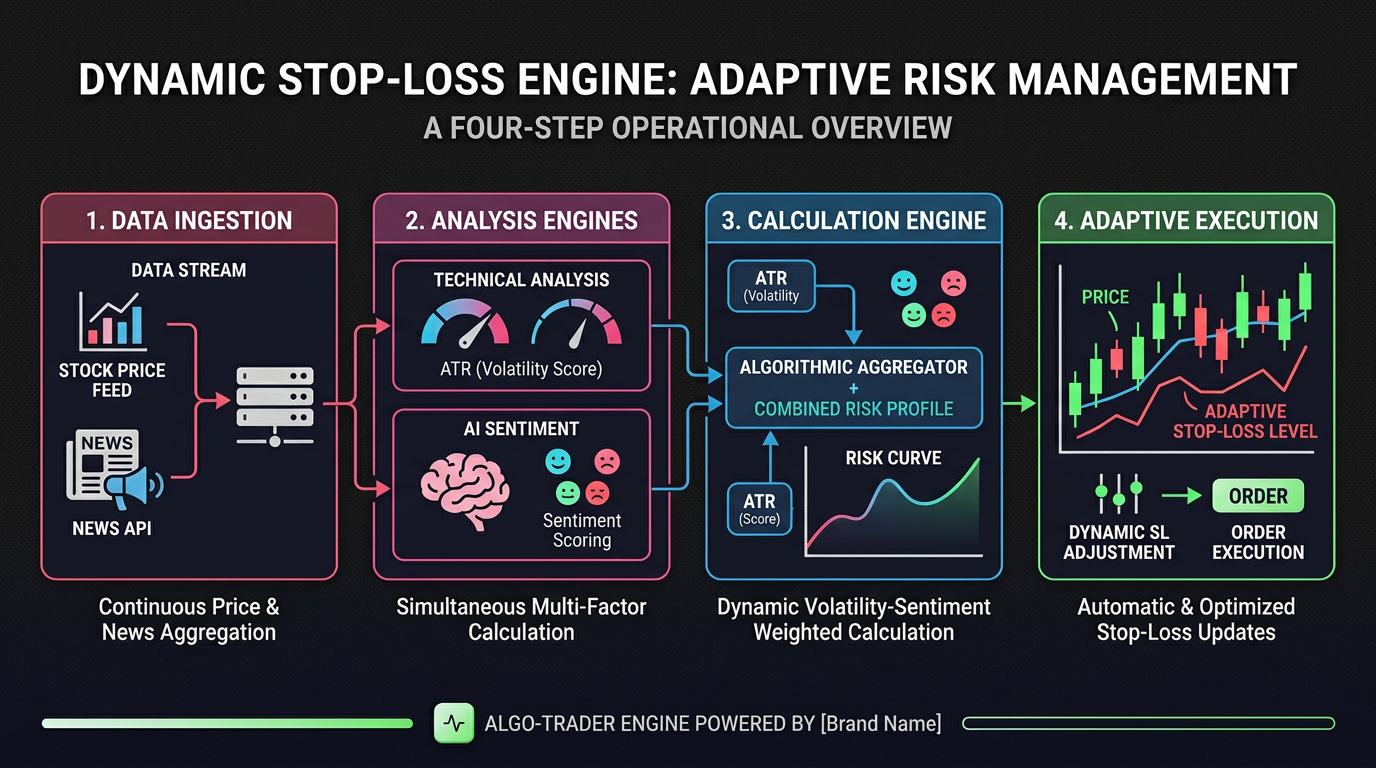
Dynamic Stop-Loss Architecture (Infographic Overview)
The relationship between price feeds, news data, and stop-loss placement can be conceptualized as an integrated intelligence loop:
- Step 1: Input Layer — Captures real-time price tick data alongside live multi-source financial news headlines.
- Step 2: Analysis Layer — Computes the technical volatility benchmark (e.g., 14-period ATR) while NLP models calculate news sentiment scores (-1.0 to +1.0) and headline impact velocity.
- Step 3: Synthesis Engine — Adjusts the protective stop cushion dynamically: widening during sudden negative headline bursts to prevent flash wicks, or tightening as trends mature smoothly.
- Step 4: Execution Output — Delivers updated stop parameters to the trader's watchlist or simulation dashboard.
Explore Trade AI Today
Ready to elevate your trading analysis with intelligent market tools? Discover how AI-powered signals, chart vision, and automated news sentiment can help you navigate market volatility with greater clarity.
Explore Trade AI Features | Start with Trading Simulation
Frequently Asked Questions (FAQ)
1. What makes a dynamic stop-loss better than a regular trailing stop?
A standard trailing stop moves upward solely based on price increases by a fixed distance or percentage. A dynamic stop-loss adjusts that distance based on changing market conditions—widening slightly when volatility and news noise spike to prevent whipsaws, and tightening when conditions stabilize to protect accrued gains.
2. Can news sentiment scoring predict exact price direction?
No. News sentiment scoring measures the tone, novelty, and prevailing bias of information surrounding an asset; it cannot guarantee future price direction. Unexpected market reactions can occur even when headlines appear unequivocally positive or negative. Always treat sentiment as one component of a holistic analysis framework.
3. How can retail traders practice dynamic stop-loss techniques without coding?
You do not need programming skills to use dynamic risk concepts. Platforms like Trade AI calculate volatility-adjusted stop-loss levels and display AI-driven news sentiment natively on the dashboard. You can also practice setting these parameters manually in Trade AI's simulated portfolio tracker.
4. What is the biggest mistake traders make with dynamic stop-losses?
The most common mistake is moving a stop-loss farther away purely out of emotion when a trade is losing. A disciplined dynamic stop-loss engine adjusts parameters systematically based on market rules and volatility—never as an excuse to hold onto a failing trade.
Disclaimer: Trade AI provides AI-generated market analysis, signals and insights for informational and educational purposes only. This content does not constitute financial, investment or trading advice, nor is it a recommendation to buy or sell any financial instrument. Markets are inherently unpredictable, and past or AI-generated analysis does not guarantee future results. Always conduct your own research and apply appropriate risk management before making any financial decision.
Frequently asked questions
- What makes a dynamic stop-loss better than a regular trailing stop?
- A standard trailing stop moves upward solely based on price increases by a fixed distance or percentage. A dynamic stop-loss adjusts that distance based on changing market conditions—widening slightly when volatility and news noise spike to prevent whipsaws, and tightening when conditions stabilize to protect accrued gains.
- Can news sentiment scoring predict exact price direction?
- No. News sentiment scoring measures the tone, novelty, and prevailing bias of information surrounding an asset; it cannot guarantee future price direction. Unexpected market reactions can occur even when headlines appear unequivocally positive or negative. Always treat sentiment as one component of a holistic analysis framework.
- How can retail traders practice dynamic stop-loss techniques without coding?
- You do not need programming skills to use dynamic risk concepts. Platforms like Trade AI calculate volatility-adjusted stop-loss levels and display AI-driven news sentiment natively on the dashboard. You can also practice setting these parameters manually in Trade AI's simulated portfolio tracker.
- What is the biggest mistake traders make with dynamic stop-losses?
- The most common mistake is moving a stop-loss farther away purely out of emotion when a trade is losing. A disciplined dynamic stop-loss engine adjusts parameters systematically based on market rules and volatility—never as an excuse to hold onto a failing trade.