Paper Trading vs Live Trading: What You Can Learn Without Risking Real Money
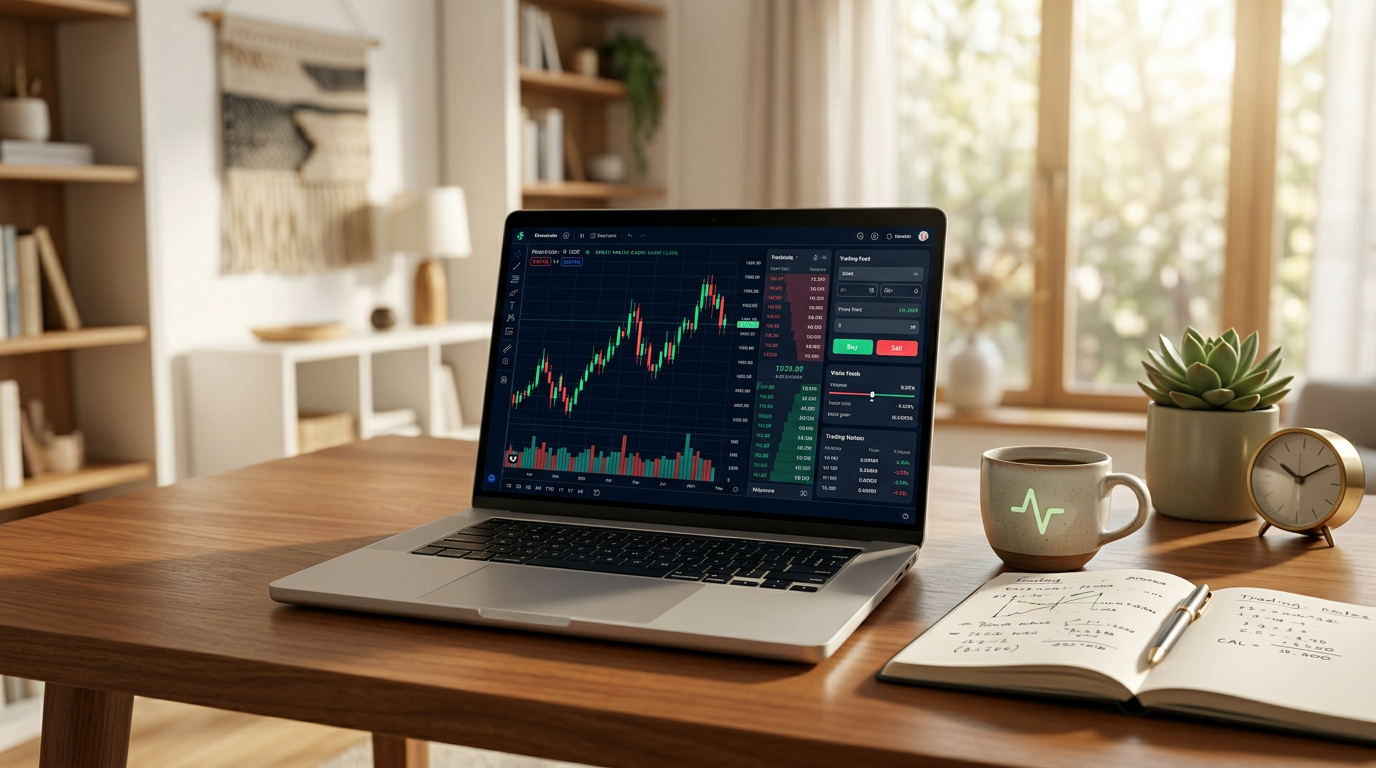
Paper Trading vs Live Trading: What You Can Learn Without Risking Real Money
Stepping into financial markets often feels like learning to pilot an aircraft. You wouldn't climb straight into the cockpit of a jet without spending dozens of hours inside a flight simulator first. Yet, every day, thousands of new traders fund live brokerage accounts and risk hard-earned money before they even understand how order types work, let alone how their own emotions respond to market volatility.
This is where the debate between paper trading vs live trading begins. Paper trading—also known as simulated trading—allows you to buy and sell equities, crypto, forex, and commodities using virtual balances that mirror live market prices. It provides an environment to test strategies, learn software interfaces, and practice risk management without putting capital on the line.
However, paper trading is not an identical replica of real-world trading. While it excels at teaching technical mechanics and analytical discipline, it cannot fully replicate the physiological stress of risking real dollars. In this guide, we break down what paper trading teaches you, where its limitations lie, and how you can combine modern tools like Trade AI's Trading Simulation and AI Trading Signals to build genuine market competence.
1. What Paper Trading Teaches You That Books Cannot
Reading about chart patterns or trading psychology in a textbook provides theoretical knowledge, but real markets move dynamically. Paper trading bridges the gap between passive reading and active execution.
Mastering Platform Mechanics
One of the most expensive mistakes novice traders make is clicking the wrong button under pressure. Accidentally submitting a market order instead of a limit order, confusing "stop-loss" with "take-profit," or mistyping position size happens regularly in live trading environments. Simulated trading lets you master:
- Placing limit, market, and stop-loss orders smoothly.
- Calculating position sizes relative to your total virtual equity.
- Navigating multiple timeframes and order books without panic.
Strategy Verification and Iteration
If you have developed a hypothesis—for instance, trading moving average crossovers on forex pairs or breakout patterns on equities—you must verify whether the strategy actually produces an edge. In paper trading, you can execute 50 to 100 sample trades to observe win rates, average risk-to-reward ratios, and maximum drawdowns.
With Trade AI, you can take this a step further by comparing your strategy hypotheses against AI Chart Analysis. You can scan a chart using live market data or upload a chart screenshot to evaluate how AI-detected support, resistance, and trend lines align with your simulated entry points.
2. The Critical Differences: Execution, Slippage, and Liquidity
While paper trading gives you a realistic sandbox, understanding its structural differences compared to live trading is essential. A common mistake is believing that paper trading success guarantees identical results in a live brokerage account.
Simulated Fills vs. Live Order Books
In a standard paper trading simulator, orders are typically filled instantaneously at the current bid or ask price. In real markets, however, execution depends heavily on market liquidity and order book depth:
- Slippage: In fast-moving markets (such as during major earnings announcements or economic data releases), market orders frequently get filled at worse prices than expected.
- Partial Fills: If you trade large share lots or illiquid cryptocurrency pairs, your order might only be partially filled, changing your risk exposure.
- Queue Position: Limit orders in live markets sit in an exchange order book queue. If price barely touches your limit level before reversing, your live order might never fill, whereas a simulated platform might mark it as executed.
To bridge this gap, modern simulated environments use real-time market data to reflect realistic price movements as closely as possible, helping you track how spreads and volume fluctuate throughout the trading day.
3. The Psychology Gap: Why Emotions Change When Money Is Real
The biggest divide in paper trading vs live trading is emotional involvement. Behavioral finance researchers, including studies cited by the Financial Industry Regulatory Authority (FINRA), frequently point out that cognitive biases—such as loss aversion and overconfidence—only become acute when financial loss is genuinely possible.
"Treating simulated trading as a video game leads to dangerous habits. Treating paper trading with the gravity of real capital builds lasting market discipline."
The Danger of "Monopoly Money" Syndrome
When you lose virtual currency, it is easy to shrug your shoulders, reset the balance, and continue without reflecting on what went wrong. In live trading, a 15% drawdown can trigger sleepless nights, revenge trading, and broken rules.
To make paper trading genuinely effective, you must treat your virtual balance as if it were your life savings. If you plan to trade a $2,000 live account, do not set your simulation balance to $100,000. Set it to $2,000 and trade the exact position sizes you plan to use in reality.
4. How to Use Trade AI to Level Up Your Simulated Trading
Trade AI is designed as a comprehensive research, analysis, and simulation platform that lets retail traders build confidence across equities, crypto, forex, and commodities without needing complex infrastructure.
Testing Setups with Trading Simulation
Trade AI's built-in Trading Simulation lets you create a simulated portfolio and test real buy/sell decisions using live market prices. You can track your virtual P&L across multiple asset classes and monitor how your portfolio balances fluctuate over time, all without placing real money on the line.
Validating Ideas with AI Trading Signals
Rather than guessing where to place risk boundaries, retail users can study Trade AI's AI Trading Signals. Each signal provides:
- Suggested entry levels
- Defined stop-loss and take-profit targets
- Directional bias (bullish/bearish)
- Supporting technical analysis and rationale
By comparing your own simulated ideas against these structured setups, you learn how experienced analysts frame risk-to-reward ratios before committing virtual or real funds.
Monitoring Risk via AI Portfolio Insights
Managing individual trades is only half the battle; managing overall exposure is what keeps you in the game. With Trade AI's Portfolio Management and AI Portfolio Insights, you can monitor your simulated holdings for risk, concentration, and diversification. If your paper portfolio is 80% concentrated in volatile small-cap tokens, the AI highlights this concentration risk, encouraging you to develop better diversification habits before you trade live.
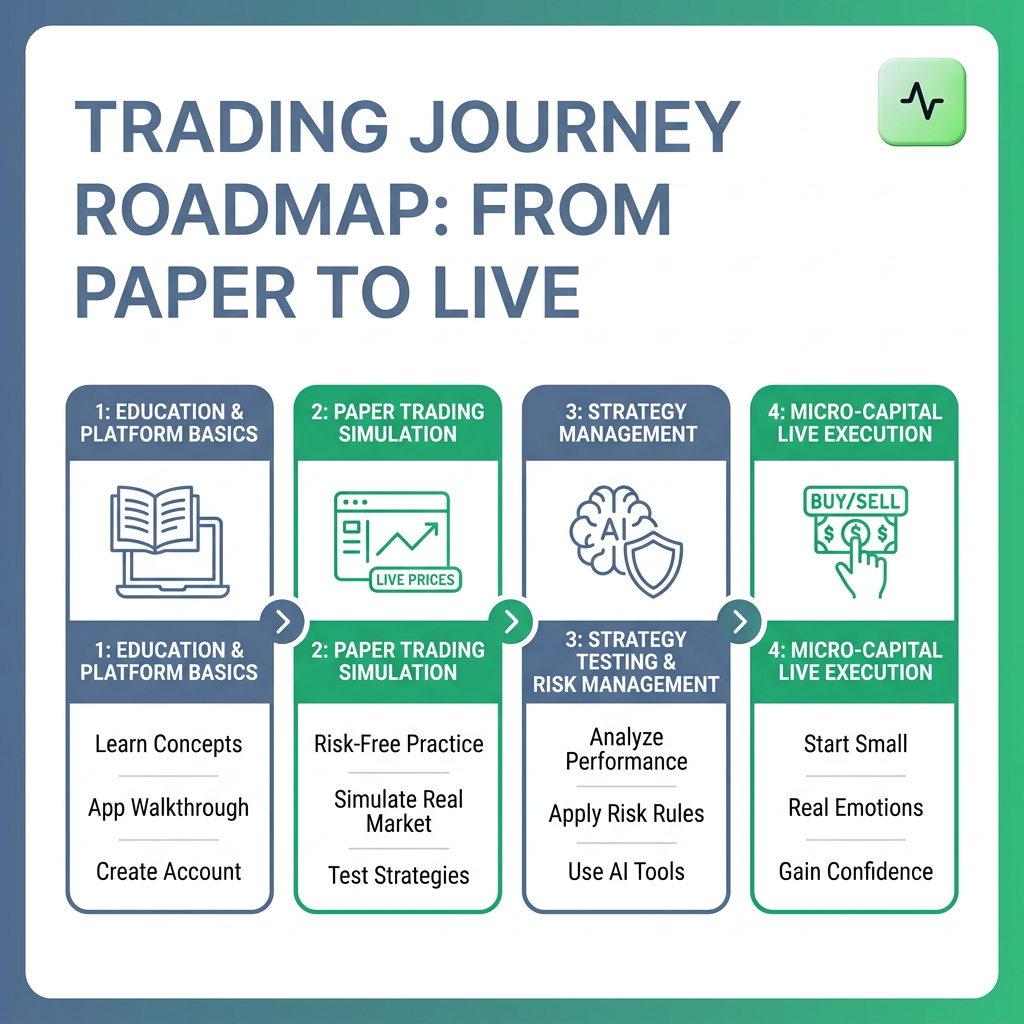
5. The Transition Checklist: When Are You Ready for Live Trading?
Transitioning from paper trading to live trading should not be based on excitement or a lucky winning streak. It should be based on systematic consistency. Ask yourself the following questions before funding a live account:
- Do I have a minimum 60-day track record? Have you logged at least two months of consistent paper trading across different market conditions (trending, ranging, and volatile)?
- Is my risk management automated? Do you place stop-loss orders on every single simulated trade without exception?
- Have I experienced a drawdown? Did you successfully manage your emotions during a string of 3 to 5 consecutive losses without increasing your position size to "make it back"?
- Am I comfortable with my platform? Can you open, adjust, and close positions quickly without hesitation or confusion?
If you answered "yes" to all four, consider transitioning with micro-positions—risking no more than 0.5% to 1% of your live account per trade while continuing to track your setups analytically.
Summary & Key Takeaways
- Paper trading builds mechanical fluency: It teaches you order execution, charting tools, and risk-to-reward structuring without the financial penalty of beginner errors.
- Live trading introduces physiological friction: Real slippage, liquidity constraints, and emotional reactions like fear and greed only manifest when capital is at stake.
- Keep simulations realistic: Match your simulation starting balance and position sizing to what you genuinely intend to use in a live brokerage account.
- Use analytical frameworks: Leverage tools like Trade AI's Trading Simulation, AI Chart Analysis, and AI Portfolio Insights to test rules-based strategies objectively.
Ready to Practice Your Strategy?
Sharpen your market instincts and test your trading theories without risking a single dollar. Explore real-time data, review AI-assisted chart analysis, and build your simulated portfolio today.
Frequently Asked Questions (FAQ)
How long should a beginner paper trade before going live?
Most market professionals recommend paper trading for at least one to three months. This timeframe ensures you experience different market regimes—such as upward trends, sideways consolidations, and volatile pullbacks—rather than judging your skill based on a short-term lucky streak.
Does paper trading show real-time market prices?
Yes. Modern platforms like Trade AI use real-time market quotes and historical data across equities, crypto, forex, and commodities, allowing you to simulate buying and selling against actual price action.
Why do so many traders succeed in paper trading but fail in live trading?
The discrepancy usually stems from emotional stress and unrealistic execution assumptions. In paper trading, traders rarely feel panic when a position moves against them, and orders fill without slippage. In live trading, fear often leads to premature exits, while greed causes traders to ignore stop-loss rules.
Can I use Trade AI solely for paper trading and education?
Absolutely. Trade AI is built specifically as a market research, intelligence, and educational platform. Retail users can utilize the Trading Simulation feature, review AI-generated signals, analyze chart screenshots, and track watchlists without connecting a live brokerage account or risking real capital.
Disclaimer: Trade AI provides AI-generated market analysis, signals and insights for informational and educational purposes only. This content does not constitute financial, investment or trading advice, nor is it a recommendation to buy or sell any financial instrument. Markets are inherently unpredictable, and past or AI-generated analysis does not guarantee future results. Always conduct your own research and apply appropriate risk management before making any financial decision.
Frequently asked questions
- How long should a beginner paper trade before going live?
- Most market professionals recommend paper trading for at least one to three months to experience multiple market conditions, including trending, range-bound, and volatile periods.
- Does paper trading show real-time market prices?
- Yes. Platforms like Trade AI utilize real-time quotes, OHLCV, and volume data across equities, crypto, forex, and commodities so your simulated orders reflect live price action.
- Why do so many traders succeed in paper trading but fail in live trading?
- The primary cause is emotional detachment during simulation. Paper traders do not feel real fear, anxiety, or greed, and they rarely experience execution slippage or partial fills common in live environments.
- Can I use Trade AI solely for paper trading and education?
- Yes. Trade AI is an informational and research platform where retail users can simulate portfolios, test AI trading signals, and analyze charts without connecting a brokerage or risking real money.