Can AI Help You Analyze Multiple Markets at Once? A Practical Multi-Market Workflow
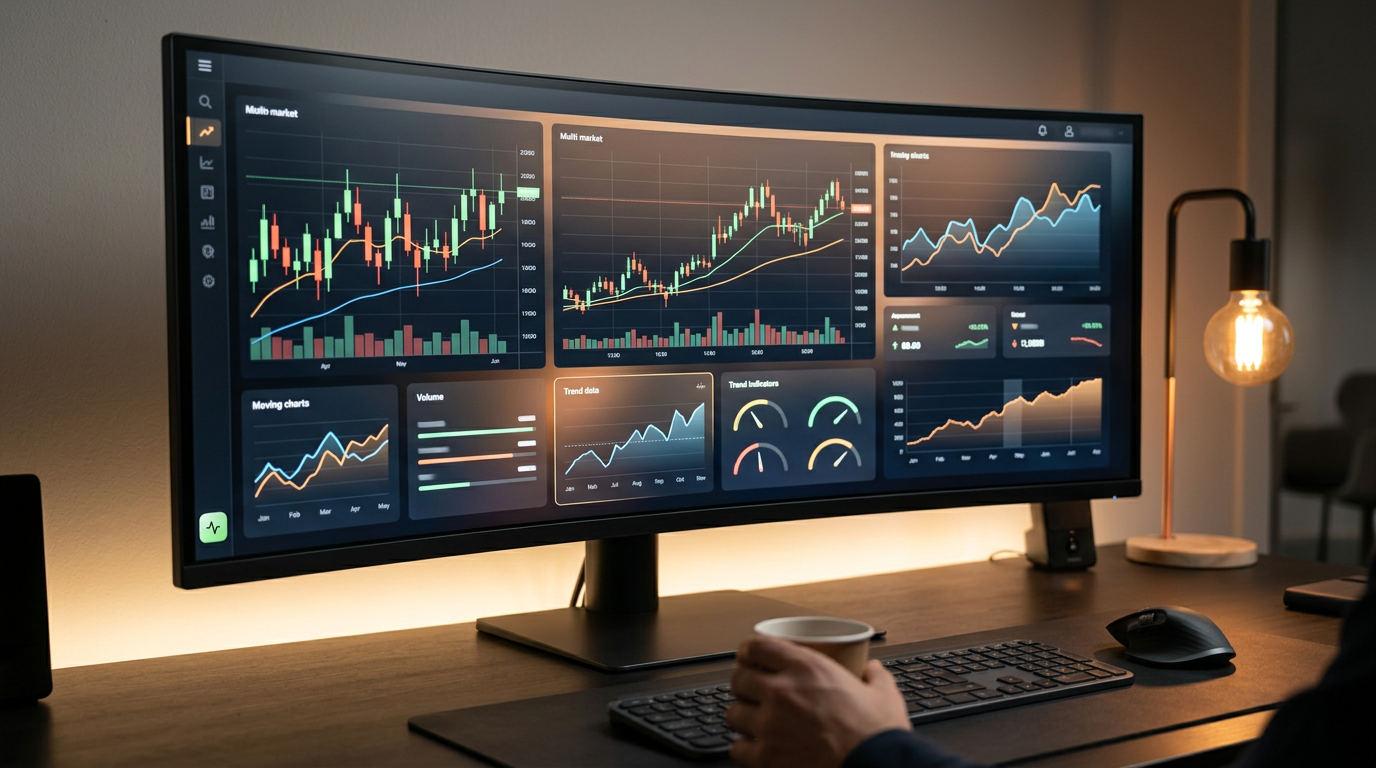
Can AI Help You Analyze Multiple Markets at Once? A Practical Multi-Market Workflow
If your daily trading routine involves twenty open browser tabs, three separate charting platforms, and an endless stream of financial news feeds, you are not alone. Modern retail market participants rarely stick to a single asset class. You might keep long-term holdings in broad-market equities, monitor gold for inflation trends, trade currency pairs during active sessions, and check crypto momentum over the weekend.
While trading across multiple asset classes offers broader diversification and more potential setups, it comes with a major catch: information overload. Trying to keep pace with foreign exchange shifts, stock earnings announcements, commodity inventories, and 24/7 crypto volume simultaneously is mentally exhausting.
This raises an important question: can artificial intelligence genuinely help you analyze multiple markets at once without overcomplicating your process?
The short answer is yes—if you use it as an analytical assistant rather than an oracle. In this guide, we will walk through a practical, step-by-step multi-market workflow showing how AI can streamline research, surface key chart patterns, and keep your multi-asset portfolio grounded.
The Multi-Market Challenge: Why Context Switching Drains Traders
Every financial market speaks its own dialect. Equities revolve around quarterly earnings reports, price-to-earnings ratios, and interest rate guidance. The foreign exchange (Forex) market reacts immediately to central bank interest rate decisions, non-farm payroll releases, and sovereign bond yields. Cryptocurrencies follow on-chain liquidity, token unlock schedules, and social sentiment, while commodities depend on physical supply chains, geopolitical conflict, and weather trends.
When you jump between these disparate sectors, your brain undergoes cognitive context switching. Switching tasks across different analytical frameworks causes mental fatigue, leading to missed support levels, miscalculated risk parameters, or emotional impulse trades.
According to research from institutions like the International Monetary Fund (IMF) on global financial stability, cross-asset correlations frequently tighten during market stress, making holistic analysis critical yet cognitively demanding. Artificial intelligence does not replace fundamental human judgment, but it excels at pattern recognition, data aggregation, and rapid contextual synthesis. By feeding live price movements, technical configurations, and market sentiment into a single analytical layer, AI enables you to maintain high-level situational awareness across asset classes in a fraction of the time.
Step 1: Centralizing Multi-Asset Watchlists in One View
Most multi-market traders fail before they even read a chart simply because their data is fragmented. When your stocks reside in one broker app, your crypto lives on a decentralized dashboard, and your forex pairs sit in a dedicated desktop terminal, your market view becomes fragmented.
An effective multi-market workflow begins by consolidating your core assets under one roof.
Building a Curated Macro Watchlist
Instead of monitoring hundreds of instruments, select two or three benchmark assets per category to gauge broad market health:
- Equities: S&P 500 (SPY), Nasdaq 100 (QQQ)
- Forex: EUR/USD, USD/JPY, US Dollar Index (DXY)
- Commodities: WTI Crude Oil, Gold (XAU/USD)
- Crypto: Bitcoin (BTC), Ethereum (ETH)
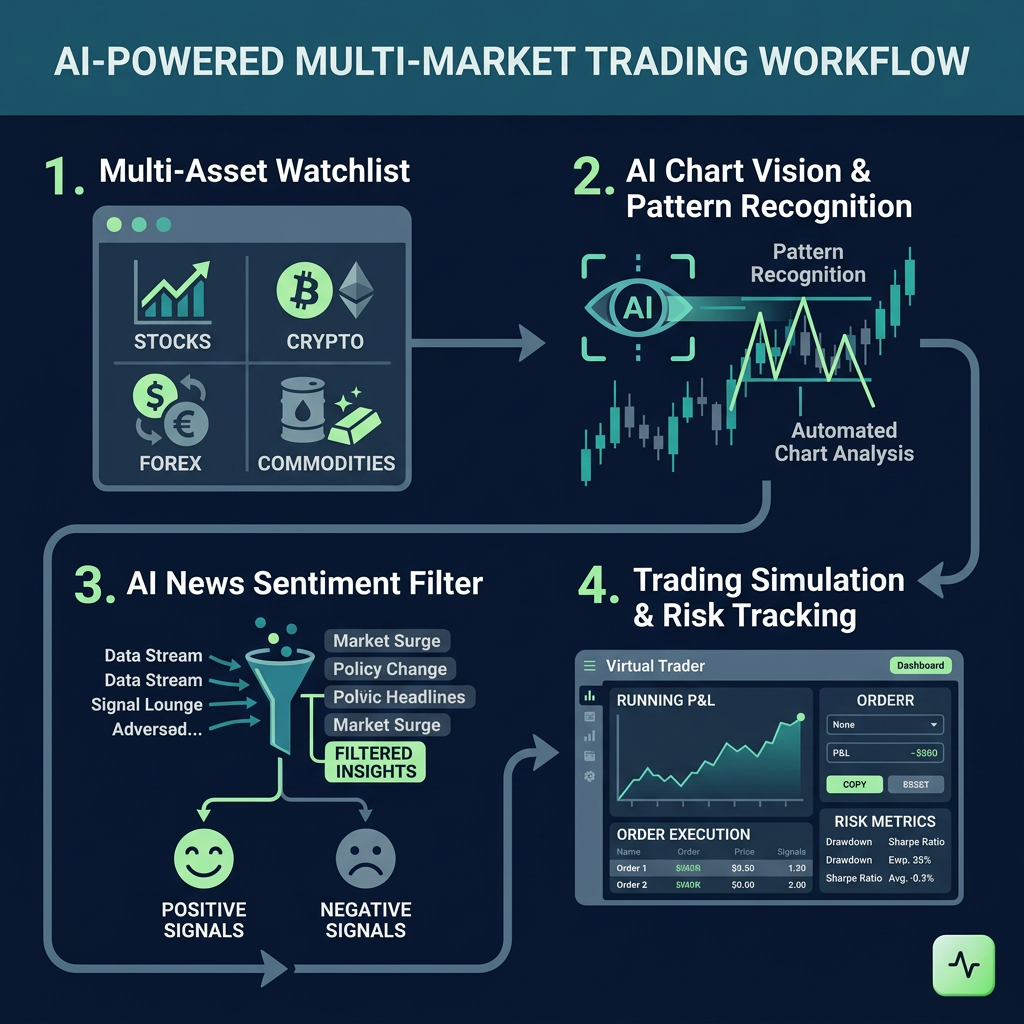
Within Trade AI's Watchlists, you can track stocks, crypto, forex pairs, and commodities side-by-side with live pricing and volume metrics. Understanding macro sentiment tracked by official entities like the Federal Reserve alongside live currency and crypto prices in a single viewport immediately reveals whether markets are in a risk-on or risk-off posture before you place a trade.
Step 2: Accelerating Technical Screening with AI Chart Analysis
Manually drawing trendlines, finding horizontal support and resistance, and checking multiple timeframes across four different asset classes takes hours. By the time you mark up your tenth chart, your focus naturally declines.
This is where AI chart vision and pattern recognition provide immediate leverage.
How AI Chart Analysis Works in Practice
Modern AI models can inspect Open, High, Low, Close, and Volume (OHLCV) price action or analyze uploaded chart screenshots to extract structural market conditions. Through Trade AI's AI Chart Analysis, you can enter a symbol or upload an existing chart image to instantly evaluate:
- Market Structure: Trend direction across higher and lower timeframes.
- Key Levels: Critical supply and demand zones, swing highs, and dynamic support.
- Chart Patterns: Triangles, head and shoulders, flags, and liquidity sweeps.
- Trade AI Signals: Objective entry context, clear stop-loss zones, and multi-target profit levels.
Rather than spending forty-five minutes confirming whether a consolidation on EUR/USD matches an ascending triangle on crude oil, AI-driven analysis provides an objective technical summary in seconds. This allows you to evaluate multiple setups across different markets without clouding your charts with subjective drawings.
Step 3: Filtering the Noise with AI News Sentiment
Financial media generates thousands of headlines every minute. Much of it is speculative noise that leads to fear of missing out (FOMO) or panic selling. However, ignoring the news entirely is equally dangerous, as macroeconomic data releases often drive cross-market volatility.
Instead of reading financial news constantly, a practical workflow leverages AI to measure market sentiment and potential asset impact.
Turning News Flow into Actionable Context
Natural language models can parse economic reports, company announcements, and financial news items to categorize market tone:
- Sentiment Scoring: Evaluating whether incoming news flows lean bullish, bearish, or neutral for a specific asset.
- Asset Impact Tagging: Determining which correlated markets are most likely to react (for example, recognizing that unexpected crude oil supply cuts impact airline stocks and inflation expectations).
- Telegram Updates: Through the Trade AI Telegram Bot, retail users can receive high-priority sentiment breakdowns and automated signal alerts right on their phones, avoiding constant screen monitoring.
By filtering macro news through an objective lens, you can determine whether a sudden market move is driven by genuine fundamental shifts or temporary liquidity sweeps.
Step 4: Testing Hypotheses Safely with Trading Simulation
One of the biggest pitfalls when expanding into unfamiliar markets is risking real capital before understanding that market's behavior. A retail equity trader moving into crypto might misjudge weekend volatility, while a crypto trader entering forex might be caught off-guard by high leverage or overnight swap rates.
Before executing trades across multiple asset classes, integrate a simulation step into your routine.
The Role of Paper Trading in Multi-Asset Mastery
With Trade AI's Trading Simulation, you can build a simulated multi-asset portfolio and execute practice orders using real-time market data. As highlighted in investor education by the U.S. Securities and Exchange Commission (Investor.gov), simulated trading is an invaluable method for practicing risk management without capital exposure. In Trade AI, this allows you to:
- Test cross-market correlation theories (e.g., trading equity indices against the US Dollar).
- Practice disciplined position sizing without financial anxiety.
- Validate AI-generated signals and chart patterns over time across equities, commodities, and digital assets.
Pairing simulated execution with AI Portfolio Insights also highlights when your multi-market ideas accidentally concentrate too much risk in a single sector, such as holding heavy tech equity positions alongside correlated Layer-1 crypto tokens.
Summary: A 15-Minute Multi-Market Routine
Here is how to bring these elements together into a focused daily routine:
- Scan the Macro Picture (3 Minutes): Review your centralized watchlist on Trade AI to identify whether global capital is trending risk-on or risk-off.
- Review High-Impact Sentiment (3 Minutes): Read AI-summarized news and sentiment scores to pinpoint events affecting equities, forex, and crypto.
- Run AI Chart Screenings (5 Minutes): Examine symbols showing unusual volume or breakouts using automated chart analysis to spot key support, resistance, and setups.
- Simulate or Plan Risk Parameters (4 Minutes): Log potential trades in your paper trading portfolio or set alerts through the Telegram bot with clear stop-loss and take-profit parameters.
Key Takeaways
- Consolidation Prevents Burnout: Monitoring diverse asset classes under a unified interface eliminates the mental friction of juggling multiple disjointed platforms.
- AI Provides Speed and Objectivity: Automated chart analysis and pattern recognition help you screen multiple assets quickly without subjective bias.
- Sentiment Clarifies Cross-Market Volatility: AI news summaries connect the dots between macroeconomic developments and price movements across stocks, currencies, and crypto.
- Simulation Protects Capital: Testing strategies across new asset classes with simulated paper trading builds experience before putting real funds on the line.
Start Your Multi-Market Analysis with Trade AI
Ready to trade smarter across stocks, crypto, commodities, and forex without the headaches of information overload? Explore Trade AI today to access real-time multi-market watchlists, automated chart vision, and risk-free trading simulations in one integrated platform.
Frequently Asked Questions (FAQ)
Can AI guarantee accurate trading predictions across different markets?
No. Financial markets are unpredictable and subject to unexpected macroeconomic shifts. Artificial intelligence serves as an analytical research tool that identifies technical patterns, summarizes sentiment, and highlights historical setups. It cannot guarantee market outcomes or eliminate trading risk.
How does analyzing multiple asset classes help retail traders?
Different markets often move in correlation or inverse correlation to one another. For example, fluctuations in crude oil or the US Dollar frequently precede movements in equity indices and foreign currencies. Tracking multiple markets provides a broader macroeconomic perspective, helping traders identify stronger trends and manage portfolio risk more effectively.
Do I need coding or algorithmic experience to use Trade AI?
Not at all. Trade AI's retail platform is designed specifically for everyday market participants. Features like multi-asset watchlists, AI chart pattern detection, portfolio tracking, and Telegram alerts work straight out of the box through an intuitive graphical dashboard.
How does paper trading help when learning multiple markets?
Every asset class features distinct liquidity, volatility, and trading hours. Paper trading allows you to test hypotheses, understand asset-specific volatility, and practice disciplined position management in a simulated environment using real-time market data without risking real money.
Disclaimer: Trade AI provides AI-generated market analysis, signals and insights for informational and educational purposes only. This content does not constitute financial, investment or trading advice, nor is it a recommendation to buy or sell any financial instrument. Markets are inherently unpredictable, and past or AI-generated analysis does not guarantee future results. Always conduct your own research and apply appropriate risk management before making any financial decision.
Frequently asked questions
- Can AI guarantee accurate trading predictions across different markets?
- No. Financial markets are inherently unpredictable. Trade AI provides analytical tools, pattern recognition, and sentiment summarization to inform research, but does not offer guaranteed forecasts or financial advice.
- How does analyzing multiple asset classes help retail traders?
- Tracking cross-market correlations—such as how currency strength or oil prices influence equity indices—gives retail traders deeper macroeconomic context to spot high-probability setups and avoid overconcentrated risk.
- Do I need coding or algorithmic experience to use Trade AI?
- No. The Trade AI individual platform is designed for retail traders and hobbyists, featuring an intuitive graphical web interface, simple screenshot uploads for chart vision, and plug-and-play Telegram alerts.
- How does paper trading help when learning multiple markets?
- Trading simulation allows traders to practice cross-asset strategies, test AI signals, and understand varying asset volatilities in real market conditions without risking actual capital.