How to Build a Multi-Asset Trading Watchlist That Actually Helps You Research
How to Build a Multi-Asset Trading Watchlist That Actually Helps You Research
If you have ever opened your trading screen to find fifty tickers blinking in red and green without any clear sense of what to look at first, you are not alone. Most retail traders begin by bookmarking every stock, coin, or currency pair mentioned on social feeds or market news. Before long, that list becomes an overwhelming digital dumping ground rather than a practical research tool.
Financial markets do not move in isolation. When crude oil spikes, airline stocks and currency pairs like USD/CAD react. When bond yields shift, high-growth technology equities and cryptocurrencies often feel the impact. A well-structured multi-asset trading watchlist connects these dots, helping you understand market narratives instead of simply reacting to isolated price swings.
Here is a practical, step-by-step guide to building a streamlined multi-asset watchlist that saves time, reduces cognitive fatigue, and genuinely supports your day-to-day research.
1. Move Beyond Single-Asset Tunnel Vision
Many retail market participants specialize strictly in one arena—trading only US equities or only crypto altcoins. While specialization has merits, tracking only one asset class blinds you to broader macroeconomic capital flows.
Modern markets are deeply interconnected. Cross-market correlation—the measurable relationship between how different asset classes move relative to one another—shapes daily liquidity and momentum. As explored by educational resources like Investopedia's guide on asset correlation, understanding these relationships is central to managing portfolio risk. For instance:
- Currencies & Commodities: A stronger US Dollar (DXY) often applies downward pressure on dollar-denominated commodities like gold and crude oil.
- Equities & Cryptocurrencies: Broader risk-on sentiment in equities (such as the S&P 500 or Nasdaq 100) often coincides with increased speculative appetite in Bitcoin and major crypto assets.
- Bonds & Equities: Rising sovereign yields can influence valuations for high-multiple growth equities.
By including benchmark assets from multiple categories alongside your primary trading candidates, your watchlist becomes an early warning radar for broader macro shifts.
2. The Four-Tier Watchlist Structure
To keep your research organized, divide your multi-asset universe into four distinct functional tiers rather than an unorganized alphabetical list.
Tier 1: Macro Gauges (The Market Pulse)
These are instruments you likely will not trade every day, but you monitor them daily to understand current market conditions:
- Equities Benchmark: S&P 500 (SPY) or Nasdaq 100 (QQQ)
- Currency Benchmark: US Dollar Index (DXY)
- Commodities: Crude Oil (WTI) and Gold (XAU/USD)
- Crypto Benchmark: Bitcoin (BTC/USD)
Tier 2: Sector & Thematic Barometers
Select instruments that reflect specific economic themes:
- Semiconductor ETFs or large-cap tech leaders
- Treasury yield proxies (e.g., 10-year Treasury note tracking)
- Key currency crosses representing regional risk, such as EUR/USD or AUD/JPY
Tier 3: Active Focus (3 to 7 Setups)
This is your active working desk. These are the specific setups you are actively researching for entry or exit within your trading timeframe. Keeping this list strictly limited to 3–7 symbols prevents decision fatigue.
Tier 4: Developing Ideas (The Incubation List)
Instruments showing interesting technical consolidation, upcoming earnings, or noteworthy narrative changes that require more time before an actionable setup emerges.
3. Organizing Multi-Asset Research with Trade AI
Maintaining quotes across multiple disparate trading apps can quickly become cumbersome. Utilizing an integrated platform simplifies tracking quotes, technical indicators, and news updates in one centralized dashboard.
Inside Trade AI Features, the Watchlists tool is engineered to display stocks, cryptocurrencies, forex pairs, and commodities side-by-side. Rather than switching between dedicated crypto screeners, forex terminals, and equity brokers, you can review live pricing, OHLCV data, percentage changes, and key indicators in a single view.
A structured watchlist transforms market noise into an actionable daily research plan.
When a candidate on your Tier 4 list approaches an interesting technical level, you do not need to manually calculate complex support and resistance zones from scratch. With Trade AI Chart Analysis, you can analyze any symbol from your watchlist—or even upload a chart screenshot—and let the platform's computer vision identify key patterns, trendlines, and support/resistance zones.
4. Pairing Sentiment and Signals with Your Watchlist
Price movement is frequently driven by news sentiment and unexpected headline risks. However, reading through dozens of financial headlines every morning wastes valuable research time.
To make your watchlist actionable:
- Filter News with AI Sentiment: Use Trade AI’s News & Market Sentiment tool to review asset-specific sentiment scoring. Instead of skimming hundreds of raw articles, you get concise breakdowns highlighting whether sentiment is leaning positive, negative, or neutral, along with potential market impact assessments.
- Verify with AI Signals: If an asset on your active focus list develops an attractive setup, compare your thesis against Trade AI Trading Signals. Trade AI generates automated signals across equities, crypto, forex, and commodities, complete with suggested entry points, take-profit targets, stop-loss markers, directional bias, and supporting technical commentary.
- Stay Alert via Telegram: Instead of staring at charts all day waiting for setups to trigger, use the Trade AI Telegram Bot to request instant chart analysis and monitor alerts directly on your mobile device.
5. Validate Before Executing: Using Simulation
One of the most common pitfalls for retail traders is acting immediately on a newly spotted watchlist idea without observing how the setup unfolds. Jumping directly into live execution often leads to emotional trading and poor position sizing.
Before allocating real capital, move candidate setups from your watchlist into the Trade AI Trading Simulation environment. Regulatory educational resources such as the SEC Investor.gov learning center emphasize the importance of understanding risk before deploying capital. The simulator allows you to build a practice portfolio, enter orders at live market prices, and test your execution timing without financial risk.
Monitoring your simulated trades alongside your active watchlist helps you learn how different asset classes behave during volatile economic announcements—such as central bank rate decisions or employment reports—without endangering your hard-earned balance.
Summary: Watchlist Management Best Practices
- Limit Active Focus: Restrict your active trading watchlist to 5–7 instruments at any one time to maintain focus.
- Include Macro Benchmarks: Always track baseline indicators (like DXY, SPY, and BTC) to evaluate prevailing market sentiment.
- Streamline Your Stack: Consolidate your equities, commodities, forex, and digital assets into a single research view using tools like Trade AI.
- Layer Technical and Sentiment Analysis: Enhance basic price tracking with AI pattern recognition and news sentiment scoring.
- Simulate First: Test unfamiliar cross-asset setups in a risk-free paper trading simulator before placing live trades.
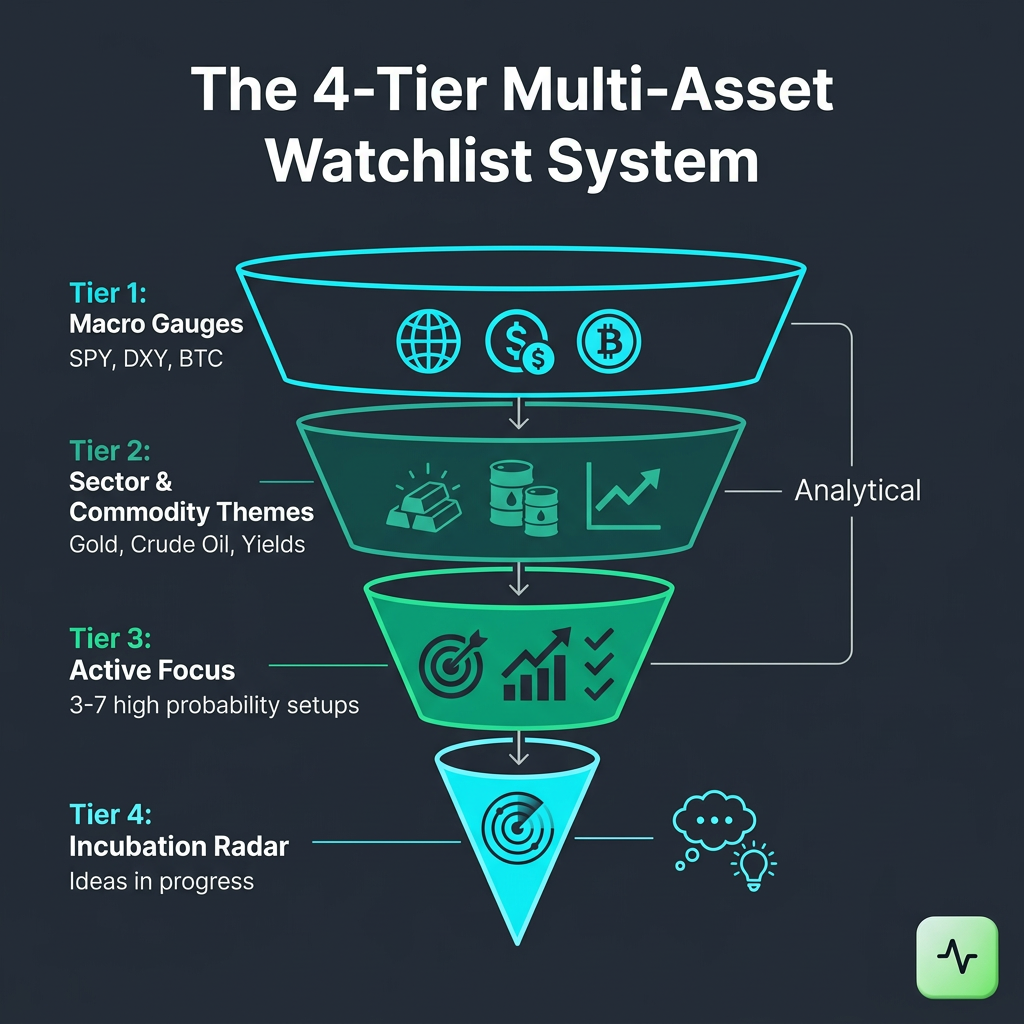
Infographic: The 4-Tier Watchlist Architecture
A systematic multi-asset research setup can be visualized as a hierarchical funnel:
- Tier 1: Macro Pulse — DXY, SPY, BTC, Crude Oil
- Tier 2: Sector & Yield Drivers — Tech, Treasuries, Key FX Crosses
- Tier 3: Active Trading Setups — 3 to 7 curated symbols ready for analysis
- Tier 4: Incubation Radar — Emerging ideas, consolidation patterns, sentiment watchlist
Start Your Market Analysis
A messy watchlist creates a chaotic trading mindset. By structuring your monitoring process across asset classes and leaning on intelligent analytics, you spend less time filtering out noise and more time conducting meaningful analysis.
Ready to elevate your daily routine? Explore Trade AI Pricing to discover unified watchlists, automated chart vision, and multi-asset intelligence tools designed to simplify your market research.
Frequently Asked Questions
How many assets should I keep on my active trading watchlist?
A reliable rule of thumb is keeping your active focus list between 3 and 7 assets. While you can keep a dozen macro barometers and incubation candidates on separate tabs, trying to actively trade or closely monitor more than seven volatile instruments simultaneously typically degrades decision quality.
Why should stock traders care about currencies or commodities?
Commodity prices and foreign exchange rates directly affect corporate earnings and economic inflation. For example, a sharp rise in energy prices impacts consumer discretionary and transportation companies, while significant currency fluctuations influence the revenue of multinational corporations reporting earnings in foreign currencies.
How does Trade AI help monitor multiple asset classes at once?
Trade AI aggregates market data across equities, cryptocurrencies, forex, and commodities into a single platform. Users can organize custom watchlists, run AI-driven chart pattern recognition, review automated sentiment scoring on breaking news, and receive trading signals—all within one interface or via the integrated Telegram bot.
Can I test watchlist strategies without risking capital?
Yes. Trade AI includes an integrated multi-asset trading simulation tool. You can open simulated positions using real-time market prices across different asset classes, allowing you to observe how your setups perform without risking real capital.
Disclaimer: Trade AI provides AI-generated market analysis, signals and insights for informational and educational purposes only. This content does not constitute financial, investment or trading advice, nor is it a recommendation to buy or sell any financial instrument. Markets are inherently unpredictable, and past or AI-generated analysis does not guarantee future results. Always conduct your own research and apply appropriate risk management before making any financial decision.
Frequently asked questions
- How many assets should I keep on my active trading watchlist?
- A reliable rule of thumb is keeping your active focus list between 3 and 7 assets. While you can keep macro barometers and incubation candidates on separate tabs, trying to actively trade or closely monitor more than seven volatile instruments simultaneously typically degrades decision quality.
- Why should stock traders care about currencies or commodities?
- Commodity prices and foreign exchange rates directly affect corporate earnings and economic inflation. For example, higher energy prices compress margins for transportation and retail firms, while significant currency fluctuations influence multinational corporate earnings.
- How does Trade AI help monitor multiple asset classes at once?
- Trade AI aggregates market data across equities, cryptocurrencies, forex, and commodities into one interface. Users can track unified watchlists, analyze charts using AI computer vision, review news sentiment scores, and receive AI trading signals directly on the web or via Telegram.
- Can I test watchlist strategies without risking capital?
- Yes. Trade AI features an integrated multi-asset trading simulation tool. You can open simulated positions using real-time market data across stocks, crypto, forex, and commodities to validate your setup timing before committing capital.