How News Moves Financial Markets: Understanding News Impact Across Assets
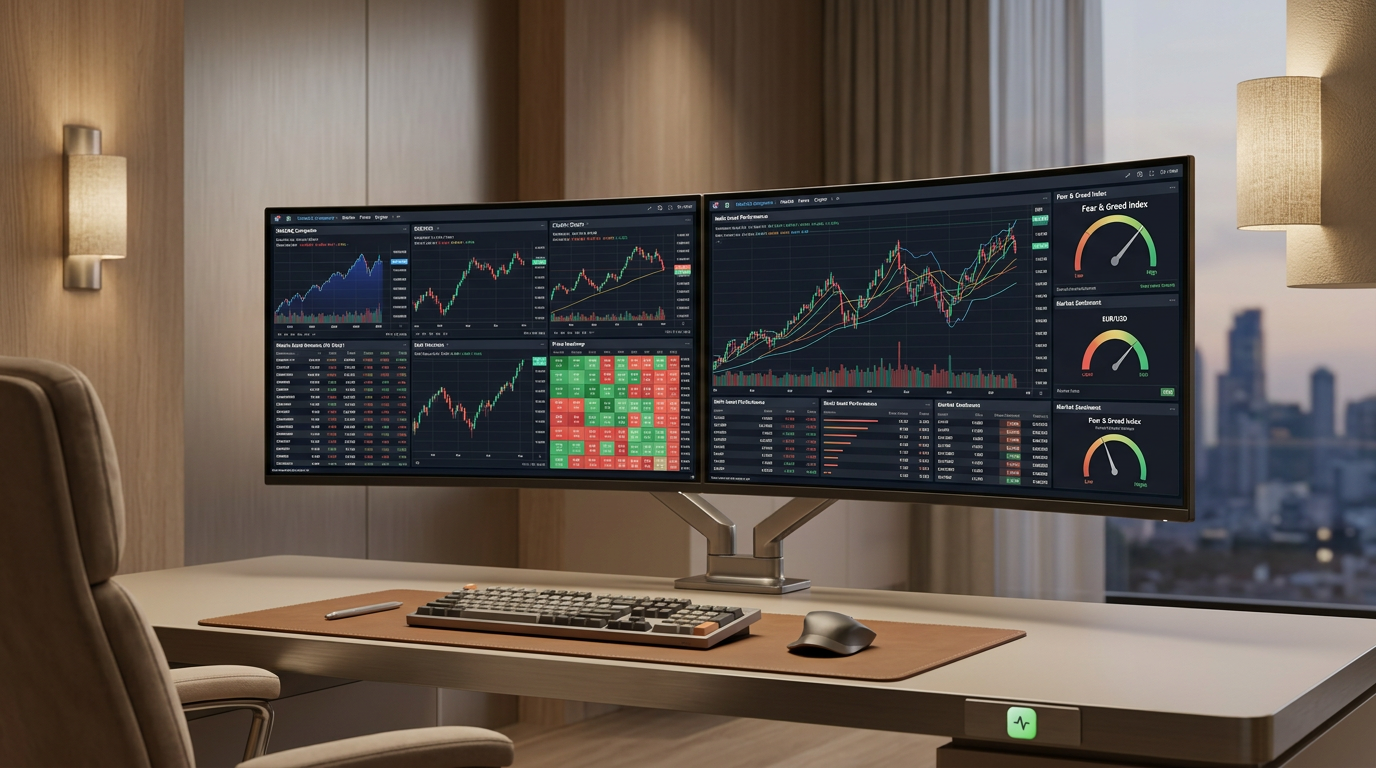
How News Moves Financial Markets: Understanding News Impact Across Assets
Have you ever watched a major earnings report beat expectations, only to see the company's stock price drop immediately after? Or noticed how a surprise rate announcement from a central bank sends shockwaves across currencies, equities, gold, and Bitcoin all at the same time?
For retail traders, understanding how news moves financial markets is often the difference between getting blindsided by sudden volatility and positioning yourself thoughtfully. Every second, millions of data points—from macroeconomic reports and corporate press releases to geopolitical developments—flood trading desks worldwide.
In this guide, we will break down the mechanics behind news-driven price action, examine how news ripples across different asset classes, and explore practical ways to turn overwhelming market headlines into structured, objective insights.
The Mechanics of Market News: Expectations vs. Reality
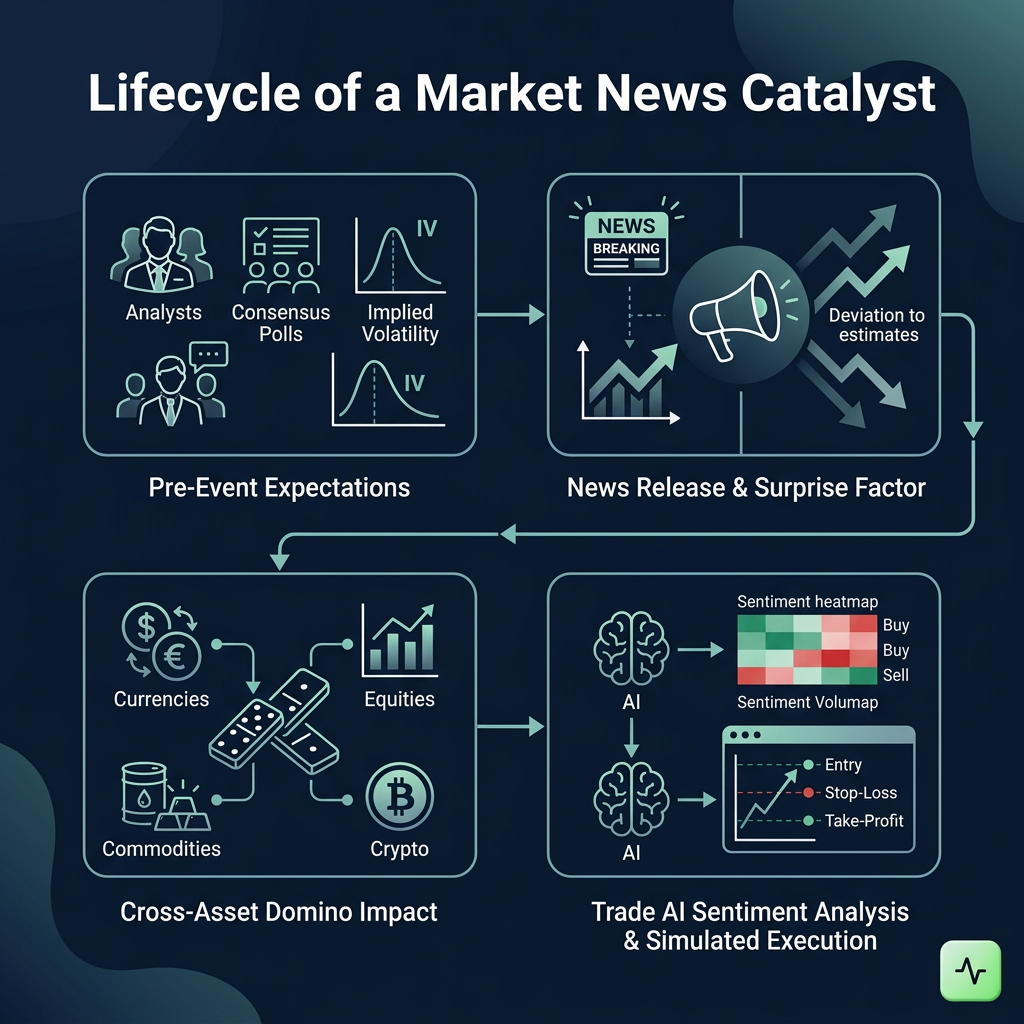
Price action rarely moves based solely on whether news is "good" or "bad." Instead, market movement is governed by the difference between what the market expected to happen and what actually occurred.
The "Priced-In" Factor
Markets are forward-looking anticipation machines. By the time a scheduled announcement arrives—such as a consumer price index (CPI) release or an interest rate decision—institutional market participants have already formed probabilistic models. Prices gradually adjust ahead of the event to reflect consensus expectations.
When the report is officially published:
- If the data aligns perfectly with consensus, the market may barely flinch or may even reverse in a classic "buy the rumor, sell the fact" reaction.
- If the data surprises in either direction, price moves rapidly as market participants scramble to re-evaluate asset valuations.
Scheduled Events vs. Breaking Headlines
Understanding news begins by categorizing the information into two primary types:
- Scheduled Macroeconomic Catalysts: Central bank rate decisions, Non-Farm Payrolls (NFP), GDP growth estimates, and corporate earnings calendars. These come with established dates and consensus forecasts.
- Unscheduled Breaking Developments: Geopolitical conflicts, sudden regulatory announcements, emergency policy changes, or executive resignations. These trigger rapid re-pricing because no baseline expectation existed.
Cross-Asset Reactions: How One Headline Echoes Everywhere
Modern financial markets do not exist in silos. Capital flows fluidly between asset classes depending on shifts in risk appetite and macroeconomic conditions. Understanding news impact across assets requires observing how a single headline ripples through multiple sectors.
Equities and Bond Yields: The Cost of Capital
Consider an unexpected uptick in inflation data. Higher inflation typically implies that central banks will maintain or raise benchmark interest rates.
- Equities: High interest rates increase borrowing costs and diminish future discounted cash flows, placing pressure on high-multiple growth and tech stocks. Conversely, financial sector stocks may benefit from widening net interest margins.
- Bonds: As rate expectations rise, bond yields climb, causing bond prices to fall.
Foreign Exchange (FX): Yield Differentials and Relative Strength
Currencies trade in pairs, meaning news is always interpreted on a relative basis. If the U.S. Federal Reserve signals tighter monetary policy while the European Central Bank remains dovish, the interest rate differential widens. Capital naturally seeks higher risk-adjusted yields, often driving the U.S. Dollar higher against the Euro.
Commodities and Crypto: Risk-On vs. Risk-Off Dynamics
Headlines also dictate broad risk sentiment:
- Safe-Haven Assets: Geopolitical tensions or economic instability generally trigger "risk-off" sentiment, funneling demand into safe-haven assets such as gold and traditional reserve currencies.
- Digital Assets: Cryptocurrencies like Bitcoin and Ethereum often trade as high-beta liquidity barometers. In periods of abundant liquidity and low interest rates, digital assets frequently experience sustained inflows. Conversely, tightening financial conditions or hawkish macroeconomic headlines can lead to swift pullbacks.
Making Sense of Sentiment: Turning Information Overload into Structured Insight
For individual traders, the primary challenge is rarely a lack of information. It is information overload. Trying to manually read dozens of news outlets, social updates, and economic feeds while watching live order books quickly leads to analysis paralysis.
This is where intelligent technology provides clarity. Rather than manually parsing every headline, traders can rely on AI-driven sentiment analysis to gauge market tone.
How AI News & Sentiment Analysis Works
Platforms like Trade AI incorporate built-in News & Market Sentiment tools designed specifically for personal market research:
- Natural Language Processing (NLP): Trade AI processes high volumes of market reports, identifying not just positive or negative keywords, but the semantic context of the reporting.
- Sentiment Scoring: Headlines are converted into standardized sentiment scores, indicating whether institutional and retail narratives are leaning bullish, bearish, or neutral.
- Potential Market-Impact Analysis: Instead of leaving you to guess what a headline means, Trade AI evaluates how the sentiment historically correlates with price action across equities, forex, commodities, and crypto.
By leveraging automated sentiment scoring, retail traders can quickly filter out distracting noise and focus on the narratives driving actual volume.
A Practical Playbook: Navigating News Volatility Without Emotional Trading
Trading during news releases can be precarious due to slippage, widening spreads, and false breakouts. Here is a disciplined, multi-step framework to manage news events effectively.
1. Build Proactive Watchlists
Instead of reacting impulsively to breaking news, keep organized lists of assets likely to be affected by upcoming catalysts. With Trade AI Watchlists, you can track selected stocks, crypto pairs, and commodities in a unified dashboard with live pricing, letting you observe early momentum shifts.
2. Stay Informed on the Go
Market catalysts rarely wait until you are sitting at a trading desk. Individual users can connect the Trade AI Telegram Bot to monitor market updates, request quick chart evaluations, and receive AI-generated insights wherever they are.
3. Test Hypotheses with Paper Trading Before Risking Capital
If you anticipate that an upcoming economic release will cause a sharp move in an asset, you do not need to risk real money to test your theory. Using Trade AI's Trading Simulation, you can build a simulated portfolio and test your buy/sell decisions using live market prices. This helps you build confidence and refine your timing without financial exposure.
4. Pair Sentiment with Technical Confirmation
News sentiment provides the macro context, but technical levels provide the execution framework. When a positive news headline breaks, consult Trade AI's AI Chart Analysis or AI Trading Signals to check whether key resistance levels have been broken or if the asset is already overbought. Combining sentiment scoring with support and resistance levels helps avoid chasing high-risk exhaustion moves.
Summary / Key Takeaways
- Expectation beats reality: Markets move based on the gap between consensus expectations and actual outcomes, not just whether a headline sounds positive or negative.
- Assets are interconnected: A single macroeconomic catalyst (such as interest rate news) simultaneously impacts equities, bond yields, currencies, and cryptocurrencies.
- Sentiment analysis reduces noise: Utilizing automated AI sentiment scoring helps translate hundreds of daily articles into actionable market context.
- Discipline over impulse: Use pre-configured watchlists, mobile alerts, and technical chart confirmation rather than jumping into volatile market spikes.
- Practice risk-free: Validate your news-trading ideas inside a simulated trading environment before committing real capital.
Explore Smarter Market Intelligence with Trade AI
Navigating fast-moving market headlines does not require hours of manual news scanning. With Trade AI, you can access multi-asset market data, AI-driven sentiment analysis, technical chart evaluations, and simulated portfolio tracking in one intuitive platform.
Take the guesswork out of market catalysts.
Explore Trade AI and Start Your Market Analysis
Frequently Asked Questions (FAQ)
Why do stocks sometimes fall after reporting positive earnings?
This usually occurs because the positive results were already "priced in" by the market prior to the announcement. Alternatively, forward-looking guidance provided by management might have been cautious, or the earnings beat fell short of whisper numbers (informal institutional expectations), prompting profit-taking.
How quickly do financial markets react to major news announcements?
Algorithmic trading desks and institutional feeds process headlines within milliseconds of publication. For retail traders, the initial seconds often bring intense spread widening and volatility. Many disciplined traders wait for the initial whip-saw price action to settle before assessing the sustained trend.
Can AI predict exactly where prices will go after a news release?
No. No technology or algorithm can predict market movements with complete certainty. AI market analysis tools examine historical patterns, parse linguistic sentiment, and assess probabilistic biases, helping traders make structured, informed choices rather than emotional guesses.
What is the safest way for beginners to learn news trading?
Beginners should avoid risking real funds during volatile news spikes. The most effective approach is using a simulated portfolio—such as Trade AI’s Trading Simulation—to practice observing how various reports impact different asset classes in real time without capital risk.
Disclaimer: Trade AI provides AI-generated market analysis, signals and insights for informational and educational purposes only. This content does not constitute financial, investment or trading advice, nor is it a recommendation to buy or sell any financial instrument. Markets are inherently unpredictable, and past or AI-generated analysis does not guarantee future results. Always conduct your own research and apply appropriate risk management before making any financial decision.
Frequently asked questions
- Why do stocks sometimes fall after reporting positive earnings?
- This usually occurs because positive results were already priced in by market consensus prior to the announcement, or the company's forward-looking guidance disappointed analysts despite past quarterly beats.
- How quickly do financial markets react to major news announcements?
- Institutional algorithms respond within milliseconds, which often causes rapid spreads and slippage immediately after a release. Retail traders generally wait for initial volatility spikes to subside to identify genuine directional trends.
- Can AI predict exactly where prices will go after a news release?
- No. AI tools cannot predict market outcomes with certainty. They analyze historical patterns, sentiment scores, and asset correlations to help users evaluate risk and probabilistic context.
- What is the safest way for beginners to learn news trading?
- The safest method is using a risk-free paper trading platform, such as Trade AI's Trading Simulation feature, to observe how macroeconomic news moves prices in real time without putting real capital at risk.