Building Event-Driven Trading Systems: Ingesting Crypto and Forex Signal Webhooks with Python and FastAPI

Building Event-Driven Trading Systems: Ingesting Crypto and Forex Signal Webhooks with Python and FastAPI
In algorithmic trading, latency and system responsiveness dictate execution quality. Traditional polling architectures—where a client application periodically queries a REST endpoint to check for new indicator states or trade setups—introduce unavoidable latency, consume excessive compute resources, and risk missing short-lived breakout windows in volatile currency and digital asset markets.
An event-driven architecture eliminates these inefficiencies. By utilizing a crypto and forex signal webhook, your execution infrastructure remains idle until a deterministic market event occurs. As soon as an algorithmic engine or computer-vision model detects a confluence pattern, it pushes a signed, structured JSON payload directly to your infrastructure.
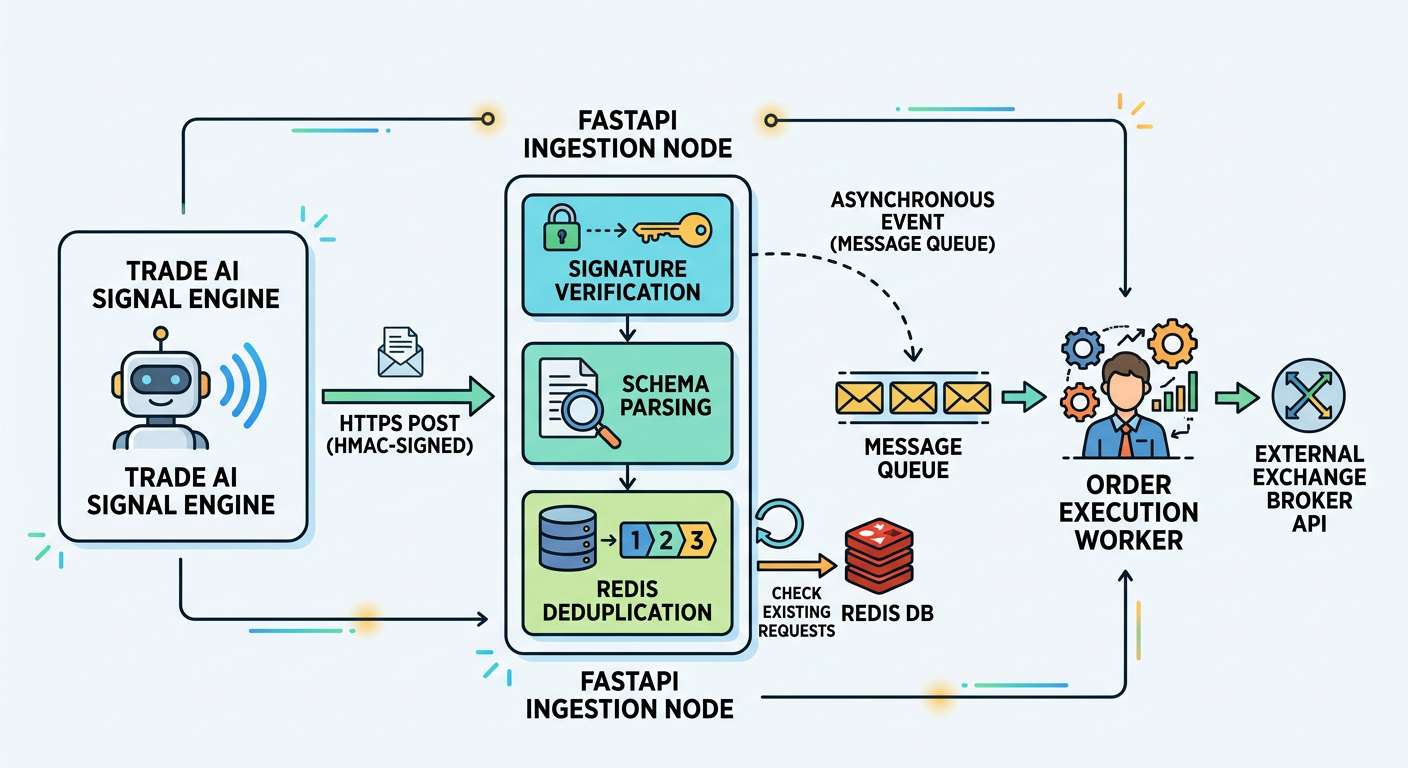
This guide demonstrates how to architect and implement an asynchronous, production-grade signal ingestion pipeline using Python, FastAPI, and Pydantic. We will cover payload validation, cryptographic HMAC verification, idempotency controls, and asynchronous task offloading.
Polling vs. Push: Why Webhooks Power Modern Algorithmic Execution
High-frequency market makers operate directly inside exchange colocation facilities via raw TCP/UDP feeds. However, for systematic retail traders, quantitative prop firms, and fintech applications running medium-to-low latency strategies, webhooks provide an optimal balance of simplicity, reliability, and cost-efficiency.
When consuming an AI trading signals API, replacing repeated polling requests with webhooks produces distinct architectural advantages:
- Zero Wasted Bandwidth: Zero empty HTTP responses when markets consolidate.
- Immediate Event Response: Signals are dispatched immediately upon candle close or indicator crossing.
- Decoupled Architecture: Upstream signal generators focus strictly on market data analytics, leaving execution logic to your specialized local microservices.
Architectural Requirements for a Resilient Webhook Ingestion Engine
A production-ready webhook receiver must satisfy four non-negotiable requirements:
- Cryptographic Authentication: Confirm the payload originated from your trusted signal provider, preventing malicious spoofing attacks.
- Schema Strictness: Validate instrument formats, price bounds, timestamps, and order sides before triggering downstream actions.
- Sub-50ms Response Time: Acknowledge receipt (
200 OKor202 Accepted) immediately. Never block the HTTP thread with heavy order routing or database writes. - Idempotency Protection: Mitigate at-least-once delivery duplicates generated by network retries.
Implementation: Building the Ingestion Service
We will construct the ingestion microservice using FastAPI, prized for its asynchronous ASGI foundation and native Pydantic schema validation.
1. Dependencies and Environment Setup
pip install fastapi uvicorn pydantic pydantic-settings
2. Defining the Strict Multi-Asset Signal Schema
Trading signals must handle both fractional cryptocurrency notations (e.g., BTC/USDT) and standard forex lot/pip notations (e.g., EUR/USD). We implement strict types using Pydantic.
from enum import Enum
from typing import Optional
from pydantic import BaseModel, Field, field_validator
from datetime import datetime

class AssetClass(str, Enum):
    CRYPTO = "crypto"
    FOREX = "forex"

class OrderSide(str, Enum):
    BUY = "BUY"
    SELL = "SELL"

class SignalPayload(BaseModel):
    signal_id: str = Field(..., description="Unique deterministic UUID from the provider")
    asset_class: AssetClass
    symbol: str = Field(..., example="BTCUSDT")
    side: OrderSide
    entry_price: float = Field(..., gt=0)
    stop_loss: float = Field(..., gt=0)
    take_profit: float = Field(..., gt=0)
    timeframe: str = Field(..., example="15m")
    timestamp: datetime
    confidence_score: Optional[float] = Field(None, ge=0.0, le=1.0)

    @field_validator("symbol")
    @classmethod
    def normalize_symbol(cls, v: str) -> str:
        return v.upper().replace("/", "").replace("-", "")
3. Cryptographic Signature Verification Middleware
To ensure payload integrity, our upstream provider calculates an HMAC SHA-256 signature over the raw request body using a shared secret key, attaching it in a custom header (e.g., X-Signature-SHA256).
import hmac
import hashlib
from fastapi import Header, HTTPException, status

WEBHOOK_SECRET = "your-production-hmac-shared-secret-key".encode("utf-8")

def verify_hmac_signature(raw_body: bytes, signature_header: Optional[str]):
    if not signature_header:
        raise HTTPException(
            status_code=status.HTTP_401_UNAUTHORIZED,
            detail="Missing cryptographic signature header."
        )

    computed_signature = hmac.new(
        WEBHOOK_SECRET,
        msg=raw_body,
        digestmod=hashlib.sha256
    ).hexdigest()

    # Use hmac.compare_digest to defend against timing attacks
    if not hmac.compare_digest(computed_signature, signature_header):
        raise HTTPException(
            status_code=status.HTTP_403_FORBIDDEN,
            detail="Invalid payload signature. Message integrity compromised."
        )
4. Asynchronous Controller with Task Decoupling
In this pattern, the server acknowledges the inbound hook in under 15ms and schedules the execution pipeline via BackgroundTasks.
import json
from fastapi import FastAPI, Request, BackgroundTasks, Header, Depends
from pydantic import ValidationError

app = FastAPI(title="Trading Signal Ingestion Engine", version="1.0.0")

PROCESSED_SIGNALS = set()

async def route_signal_to_execution_engine(signal: SignalPayload):
    print(f"[ORDER ROUTER] Processing {signal.asset_class.value} order: "
          f"{signal.side.value} {signal.symbol} at {signal.entry_price}")

@app.post("/api/v1/signals/webhook", status_code=202)
async def ingest_trading_signal(
    request: Request,
    background_tasks: BackgroundTasks,
    x_signature_sha256: Optional[str] = Header(None)
):
    raw_body = await request.body()
    verify_hmac_signature(raw_body, x_signature_sha256)

    try:
        payload_dict = json.loads(raw_body.decode("utf-8"))
        signal = SignalPayload(**payload_dict)
    except (json.JSONDecodeError, ValidationError) as e:
        raise HTTPException(status_code=422, detail=f"Malformed signal schema: {str(e)}")

    if signal.signal_id in PROCESSED_SIGNALS:
        return {"status": "ignored", "detail": "Duplicate signal dropped"}

    PROCESSED_SIGNALS.add(signal.signal_id)
    background_tasks.add_task(route_signal_to_execution_engine, signal)

    return {"status": "accepted", "signal_id": signal.signal_id}
Critical Production Edge Cases
Moving an automated trading system from paper simulation to live capital requires accounting for real-world distributed networking problems.
Slippage and Expiration Gates
A signal generated on a short timeframe has a narrow expiration window. If upstream latency delays payload delivery, executing at current market rates may drastically compromise risk metrics. Compare the inbound signal with a real-time market data REST API feed before routing trades.
Distributed Deduplication with Redis
In-memory sets reset upon application restarts and do not share state across horizontally scaled clusters. For multi-replica deployments, use Redis with an explicit key expiry TTL to maintain an atomic idempotency record across your infrastructure.
Integrating with Trade AI Signal Feeds
The Trade AI platform combines technical indicator calculations with computer vision models, analyzing candlestick patterns across thousands of pairs simultaneously. Rather than maintaining heavy custom indicator pipelines, developers can configure webhooks directly via the Trade AI API documentation.
Furthermore, developers building trading communities can forward verified signals downstream to an automated telegram trading bot or an MT5 bridging microservice.
Disclaimer: This guide is provided strictly for educational and technical software engineering purposes. It does not constitute financial, investment, or trading advice. Algorithmic trading carries significant capital risk. Always test trading infrastructure extensively in sandboxed paper-trading environments before connecting real capital.
Frequently asked questions
- What is the difference between an API poll and a trading webhook?
- Polling requires your system to continuously send requests to an API at fixed intervals to check if a new trade setup has occurred, wasting compute and introducing latency. A webhook is an event-driven push architecture where the signal provider sends an HTTP POST request to your server immediately when conditions are met.
- Why is HMAC signature verification critical for trading webhooks?
- Without cryptographic verification, anyone who discovers your webhook URL could transmit fraudulent signals, triggering unauthorized market orders. HMAC SHA-256 signatures ensure that payloads originate exclusively from your verified provider and have not been tampered with in transit.
- How do you handle duplicate webhook events in algorithmic trading?
- Duplicate prevention is managed using an idempotency key (such as a unique signal UUID). Upon receipt, your listener checks an atomic storage layer (like Redis) for the ID. If the ID exists, the duplicate payload is discarded immediately before touching any order execution components.
- What response code should a webhook listener return?
- A webhook listener should return an HTTP 202 Accepted or 200 OK status code within milliseconds after validating the signature and payload structure, deferring actual order placement or message broadcasting to asynchronous background workers.