AI Trading Signals Explained: How to Interpret Entry, Stop-Loss and Take-Profit Levels
AI Trading Signals Explained: How to Interpret Entry, Stop-Loss and Take-Profit Levels
Artificial intelligence has quickly transformed how everyday market participants research financial assets. For retail traders navigating fast-moving equities, foreign exchange, commodities, and digital currencies, AI trading signals have emerged as one of the most popular tools to streamline market data. Instead of spending hours plotting manual trendlines across dozens of charts, traders can review structured, data-driven ideas generated by machine learning models in seconds.
However, receiving a signal notification on your screen or smartphone is only the first step. The real skill lies in interpreting what those price numbers actually mean. An alert showing a recommended ticker, an entry price, a protective stop, and profit targets is not an automatic instruction to click "buy." It is a structured risk-management framework.
In this guide, we break down how modern AI-generated signals work, examine each core component using practical examples, and demonstrate how to validate them safely before making any market decisions.
What Are AI Trading Signals and How Do They Work?
At its core, an AI trading signal is an algorithmic output derived from processing complex market data—including historical price trends (OHLCV), technical indicators, pattern recognition, and real-time volume. Rather than relying on gut feeling, advanced machine learning models scan multi-asset markets to identify statistical edges where price action has historically moved in a specific direction.
When you use an analysis platform like Trade AI, these algorithms monitor markets across equities, crypto, forex, and commodities to identify setups that meet specific technical criteria. Instead of delivering vague commentary, a structured signal packages the setup into quantifiable parameters:
- Asset & Timeframe: Which symbol is being tracked and over what horizon (e.g., 1-hour swing vs. daily trend).
- Market Bias: Whether the signal reflects a bullish (long) or bearish (short) outlook.
- Entry Level: The optimal price or zone to consider entering the position.
- Stop-Loss Level: The boundary where the original setup is no longer valid.
- Take-Profit Targets: Pre-calculated levels where taking profit makes statistical sense.
- Supporting Rationale: The underlying technical indicators, trendlines, or pattern detections that triggered the alert.
By viewing signals as structured hypotheses rather than predictive guarantees, you shift from blind copying to disciplined evaluation.
Deconstructing the Anatomy of a Signal
To understand how to act on an alert, let's deconstruct the three price markers that define every trade idea.
[EXAMPLE SIGNAL: AAPL (1-Hour Chart)]
Bias: Bullish
Entry Zone: $182.50 – $183.00
Stop-Loss: $179.80
Take-Profit 1: $186.00
Take-Profit 2: $189.50
Rationale: Bullish divergence on RSI, retest of 50-period SMA support.
1. The Entry Price (and Entry Zone)
The entry level indicates where the algorithm detected an optimal risk-to-reward balance. In real-world market conditions, prices move fluidly. That is why professional analysis often considers an entry zone rather than a single fixed cent.
If the asset has already gapped substantially past the recommended entry before you open your platform, jumping in late can distort your entire risk-to-reward ratio. Recognizing an entry level means understanding patience: wait for price to enter the designated territory rather than chasing momentum.
2. The Stop-Loss (Protecting Your Capital)
The stop-loss is arguably the most vital number in any trade setup. It defines the exact price at which the analytical thesis fails. In our AAPL example, the stop-loss sits at $179.80—just below a key support cluster.
If the price drops below $179.80, the setup's technical thesis is broken. The stop-loss is not an admission of defeat; it is your insurance policy. Setting an automatic order based on this level ensures that a small, controlled loss never turns into an account-threatening setback. Authoritative investor education resources like Investopedia's guide to stop-loss orders continually emphasize that capital preservation is what keeps retail traders solvent over the long term.
3. Take-Profit Levels (Scaling Out Systematically)
Beginner traders often struggle with exits more than entries. When in profit, greed urges traders to hold too long, while fear pushes them to close winning trades too early. High-quality AI trading signals solve this psychological dilemma by providing multiple tiered take-profit targets (TP1, TP2, TP3).
- TP1 (Conservative): Designed to capture the first major resistance zone. Many disciplined traders use TP1 to close half of their position and move their stop-loss to breakeven, securing a risk-free trade.
- TP2 & TP3 (Extended): Designed to let the remaining portion ride toward higher-timeframe resistance if the trend accelerates.
Understanding the AI Rationale: Context Over Blind Execution
A common mistake among retail traders is treating artificial intelligence as a "black box"—seeing a notification and placing a live order without knowing why. Robust market platforms provide the analytical rationale behind the numbers.
On Trade AI, every signal comes accompanied by transparent context, highlighting factors such as moving average confluences, candlestick patterns, or overbought/oversold indicator thresholds. For instance, if a signal suggests a long position on EUR/USD, the rationale might note an oversold hourly RSI coupled with support at a major daily Fibonacci level.
You can deepen your perspective by pairing signal alerts with complementary features:
- AI Chart Analysis: Upload a chart or analyze the symbol directly within the platform to double-check trendlines, chart patterns, and dynamic support/resistance levels.
- News & Market Sentiment: AI sentiment scoring reviews breaking headlines and macroeconomic releases, alerting you if an upcoming interest rate decision or earnings call could disrupt technical patterns.
- Telegram Bot Delivery: Receive these multi-layered updates directly inside your messaging workflow, complete with reasoning you can review at a glance.
Reviewing the rationale ensures you never take a trade you don't intuitively understand.
Evaluating Risk-to-Reward and Managing Your Portfolio
Before deciding whether a signal fits your portfolio, you must evaluate its Risk-to-Reward Ratio (R:R). This simple calculation compares how much money you stand to lose if stopped out versus how much you aim to gain at your target.
Using our earlier AAPL example:
- Risk: Entry ($182.50) – Stop-Loss ($179.80) = $2.70 per share
- Reward (TP1): Target ($186.00) – Entry ($182.50) = $3.50 per share (~1:1.3 R:R)
- Reward (TP2): Target ($189.50) – Entry ($182.50) = $7.00 per share (~1:2.6 R:R)
As a rule of thumb, many market participants prioritize setups offering at least a 1:1.5 or 1:2 ratio to the final target. Over a sample of 50 trades, maintaining a positive risk-to-reward ratio allows your portfolio to grow even if your win rate is only around 50%.
Practicing with Trading Simulation First
If you are new to interpreting signal structures, you do not need to risk real money immediately. A core feature of Trade AI is its built-in Trading Simulation. You can test entries, track how stop-losses behave, and see how take-profit scaling impacts your simulated portfolio using live market quotes.
By paper trading alerts inside a risk-free sandbox, you build the muscle memory required to manage orders cleanly before trading live capital.
Limitations and How to Use Signals Responsibly
While artificial intelligence processes massive datasets faster than any human can, it operates within real-world boundaries that every trader must respect:
- AI Does Not Predict the Future: Machine learning evaluates probabilities based on historical precedents. Unforeseen geopolitical events, flash crashes, or sudden interest rate changes can invalidate any technical setup immediately.
- Slippage and Volatility: In volatile environments—especially in crypto and fast-breaking forex pairs—prices can move rapidly between the generation of an alert and your order execution.
- Risk Lies With the Trader: Algorithms do not know your account size, personal financial obligations, or tolerance for drawdowns. You must always decide how much capital to allocate.
Understanding these limitations transforms AI from an unrealistic "magic crystal ball" into what it actually is: a highly efficient, objective research assistant.
Summary / Key Takeaways
- Signals Are Frameworks, Not Commands: An AI signal offers a structured thesis consisting of entry zones, invalidation points, and profit targets.
- Honor the Stop-Loss: Your stop-loss level protects your capital. Never widen or remove a stop-loss when price moves against your thesis.
- Scale Out Using Tiered Targets: Utilize TP1 to de-risk positions and let remaining shares run toward TP2 or TP3.
- Verify the Rationale: Use tools like AI Chart Analysis and News Sentiment to understand the "why" behind the alert.
- Simulate Before Trading Live: Use paper trading environments to test how signals play out without risking hard-earned capital.
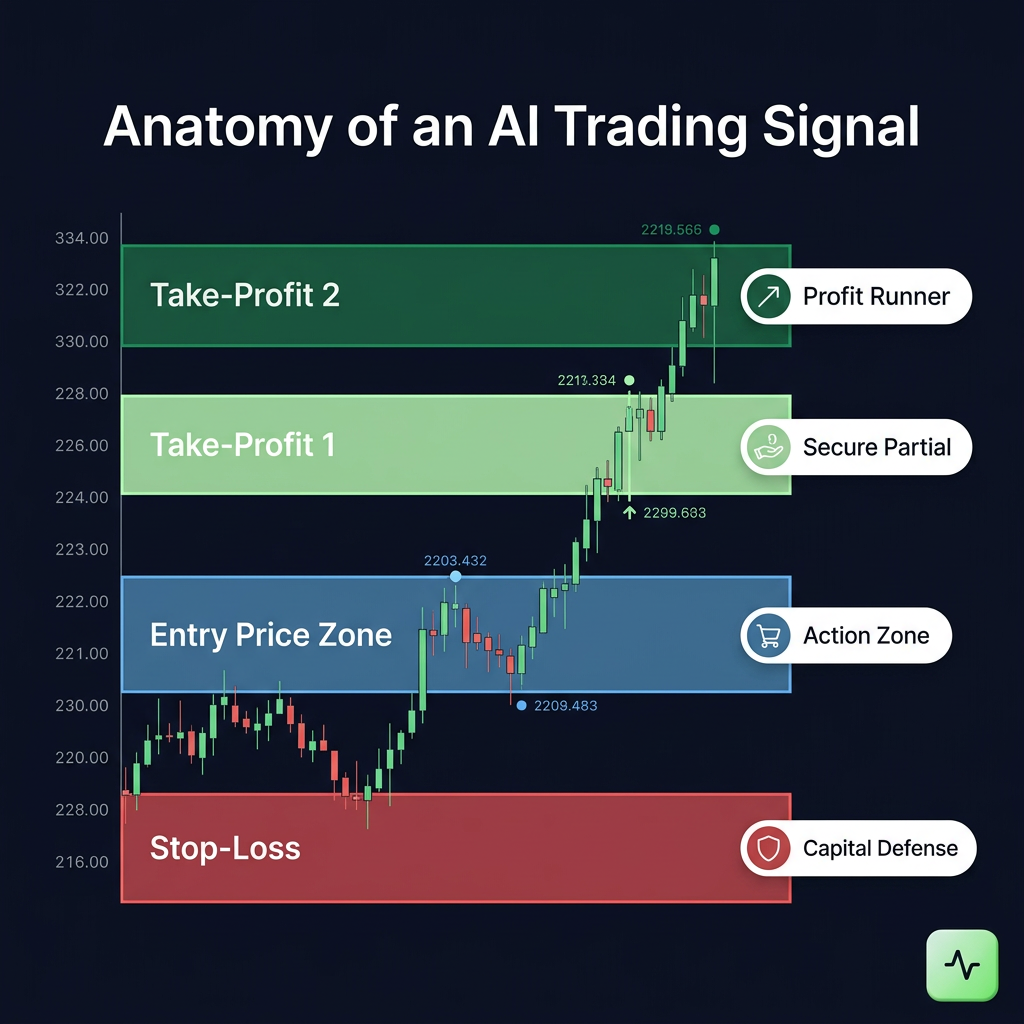
Infographic: Anatomy of an AI Trading Signal
Visualizing your risk levels makes complex multi-tier exits easy to understand at a glance:
- Take-Profit 2 ($189.50): Extended runner target to maximize profits once initial risk is removed.
- Take-Profit 1 ($186.00): Conservative initial resistance level for partial profit-taking and moving stops to breakeven.
- Entry Zone ($182.50 - $183.00): Calculated entry zone ensuring optimal mathematical risk-to-reward.
- Stop-Loss ($179.80): Decisive invalidation point safeguarding your trading capital against market downturns.
Start Your Market Analysis
Ready to elevate your daily research? With Trade AI, you can explore real-time market data, generate multi-asset signals, analyze chart screenshots with computer vision, and practice your execution in a simulated portfolio—all in one intuitive workspace.
Take the guesswork out of market navigation and build a disciplined trading routine today.
Frequently Asked Questions (FAQ)
What should I do if the price moves past the entry level before I see the signal?
If the market price has moved significantly beyond the designated entry zone, it is generally best to let the trade go. Chasing a price increases your downside risk and reduces your reward potential, throwing off the intended risk-to-reward ratio. Wait for a pullback to the entry zone or look for the next signal.
Can I adjust the stop-loss level provided by an AI signal?
You can adjust your position sizing or place a tighter stop if your personal risk tolerance requires it. However, you should generally avoid widening your stop-loss further away from the entry, as doing so increases your potential loss beyond what the analytical model calculated.
Across which financial markets can Trade AI generate signals?
Trade AI generates analysis and signal frameworks across multiple global asset classes, including stocks (equities), cryptocurrencies, forex pairs, and commodities.
How does paper trading help when learning AI trading signals?
Paper trading lets you simulate buys and sells against live market quotes without risking real money. This allows you to evaluate how signals perform, test how you handle market volatility psychologically, and refine your execution speed before funding a live account.
Do AI trading signals guarantee winning trades?
No. Financial markets are inherently unpredictable, and no algorithmic system can guarantee profits or forecast price movements with complete certainty. Signals should always be treated as educational tools to support your independent research.
Disclaimer: Trade AI provides AI-generated market analysis, signals and insights for informational and educational purposes only. This content does not constitute financial, investment or trading advice, nor is it a recommendation to buy or sell any financial instrument. Markets are inherently unpredictable, and past or AI-generated analysis does not guarantee future results. Always conduct your own research and apply appropriate risk management before making any financial decision.
Frequently asked questions
- What should I do if the price moves past the entry level before I see the signal?
- If price has moved beyond the recommended entry zone, avoid chasing it. Chasing worsens your risk-to-reward ratio. It is safer to wait for a retracement back into the entry zone or wait for a new setup.
- Can I adjust the stop-loss level provided by an AI signal?
- You can tighten your stop or adjust your position sizing to fit your risk tolerance, but you should avoid widening the stop-loss, as that increases downside exposure beyond the model's intended risk limit.
- Across which financial markets can Trade AI generate signals?
- Trade AI generates structured signals and market analysis across equities (stocks), cryptocurrencies, forex pairs, and commodities.
- How does paper trading help when learning AI trading signals?
- Paper trading allows you to test entries, manage stop-loss executions, and observe multi-target profit taking in real-time simulation without putting actual money at risk.
- Do AI trading signals guarantee winning trades?
- No. Markets are inherently unpredictable and past statistical patterns do not guarantee future performance. AI signals should be used as educational guides alongside personal risk management.